The Boy on the Train

March 9, 2026

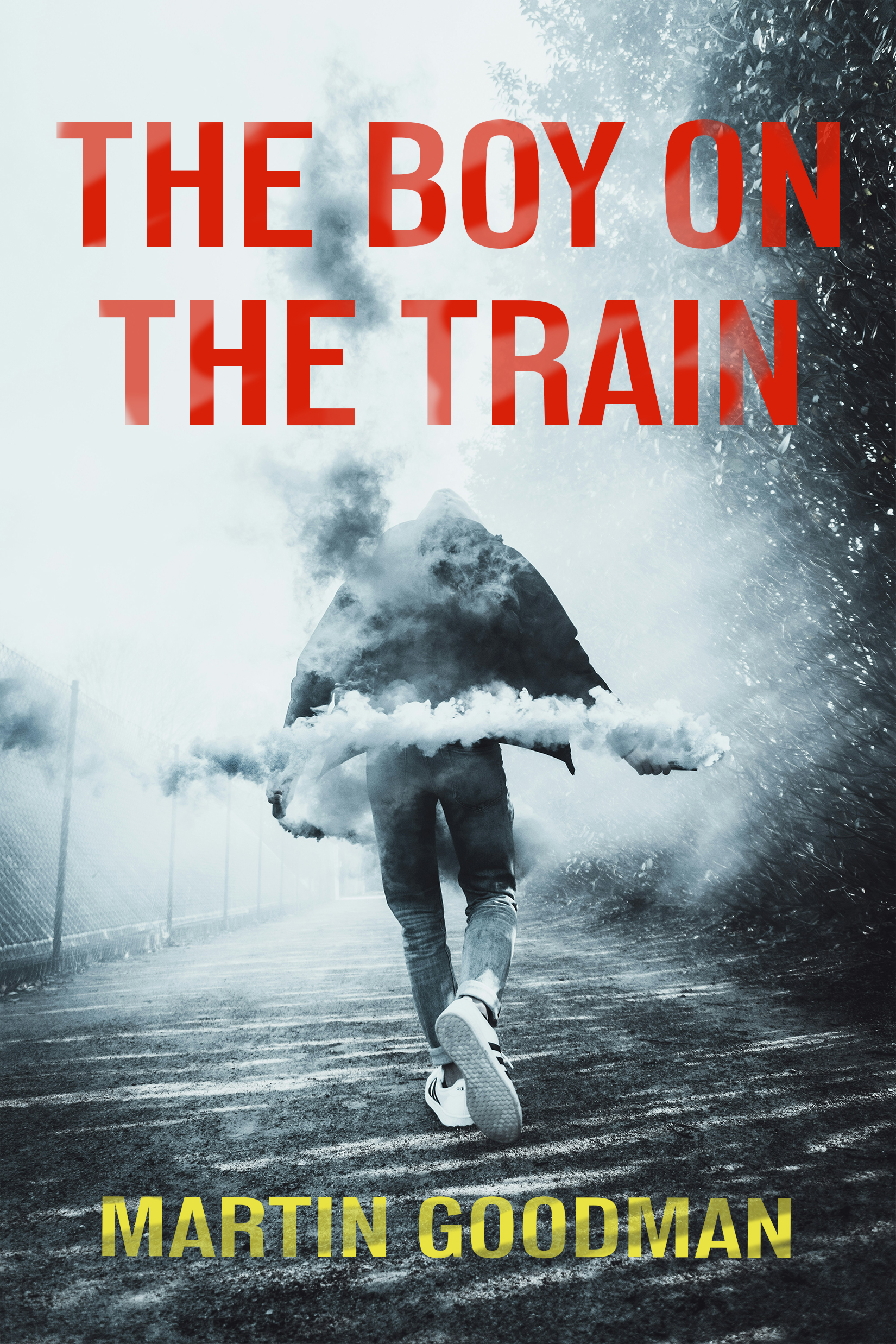
A seventeen-year-old boy sits opposite a man on a train. No weapon is drawn. No threat is made. Yet by the time Tom Snelling reaches his destination, he has chosen his victim — and begun one of the most methodical, devastating crimes in recent crime fiction.

Steve McInnes is a coal broker. He is also, in Tom’s eyes, guilty of crimes against the planet. The punishment Tom devises is meticulous and merciless: fabricated evidence, planted images, a reputation dismantled file by file. Steve will be arrested, tried in the court of public opinion, and destroyed — for things he didn’t do.

The Boy on the Train is a crime novel of unsettling moral precision. It asks who the criminal really is, whether a just motive can excuse a monstrous method, and how completely one person can erase another’s life without ever leaving a fingerprint. In Tom Snelling, Martin Goodman has created one of crime fiction’s most chilling and compelling perpetrators — a boy who believes, utterly, that he is the good guy.
Review in The Hackney Citizen

The Bishnoi temple at Lohawat

February 27, 2025

A ‘miracle’ story about Guru Jambhoji

Birbal Bishnoi
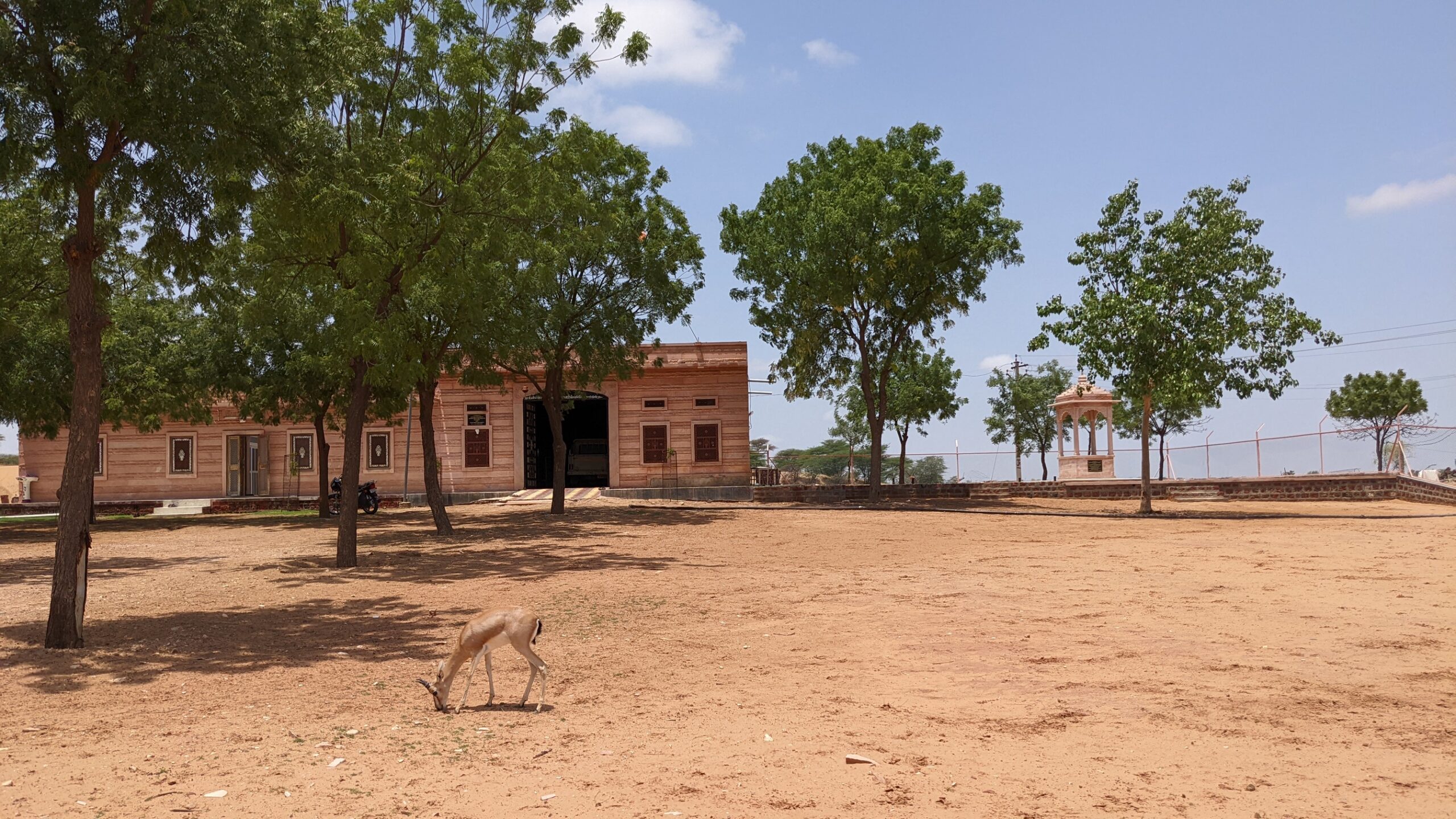
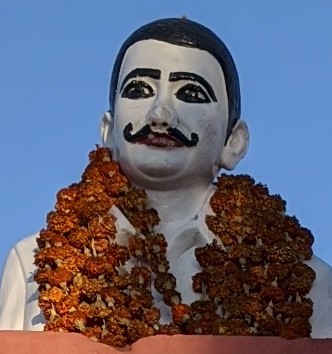
(The setting: Lohawat is a village in the Thar Desert northwest of the city of Jodhpur. Businesses that line the road, such as a garage and motorcycle sales office, carry the name of Guru Jambheshwar – the more formal name of the Bishnoi’s founding guru Jambhoji.  The guru’s father, Lohat, is said to have come from this village. The Bishnois have set up a sanctuary on the outskirts of the village, which cares for wounded animals before returning them to the wild. Heading out from town you reach the statue to the late 20th century Bishnoi martyr Birbal Bishnoi, killed while defending gazelles from poachers [his story and those of others from the village are told in My Head for a Tree]. In honour of Birbal, the surrounding land was given official conservation status. On my visit in 2020 it the land was filled with grazing chinkara, a graceful gazelle. In 2022 there were none, most likely due to attacks from feral dogs which frighten wildlife from homesteads around which these dogs congregate. Birbal’s statue faces a road leading up a hill, a compacted sand dune, which holds the Bishnoi temple where this story unfolds.)

Let me introduce a young Bishnoi priest: Swami Aatmanand Ji Maharaj Lohawat . At just fourteen years old the words of Guru Jambhoji, the 15th century founder of his religion, pulled him toward the temple at Lohawat where he became a disciple of the resident priest. There are no training schools for Bishnoi priests: discipleship is the route towards priesthood. You learn to lead the services, study the sacred texts, and offer support and spiritual guidance to your community. When your priest decides you are ripe for ordination, you travel to the Bishnoi temple at Jambha.

For regular followers, the lead temple is seen as being Mukam, where Guru Jambhoji is buried. For priests, it is the temple at Jambha. Inside the town of Jambha is a residential block akin to a monastery, where I once ate inside a cloister alongside a flurry of hungry, youngish men in saffron robes. When a disciple is being elevated to priesthood he comes here, he calls existent priests to a feast he provides, introduces himself, and offers himself in service. There are two levels of priests: sants (curiously translated into English as ‘saints’), and senior to them, mohants.

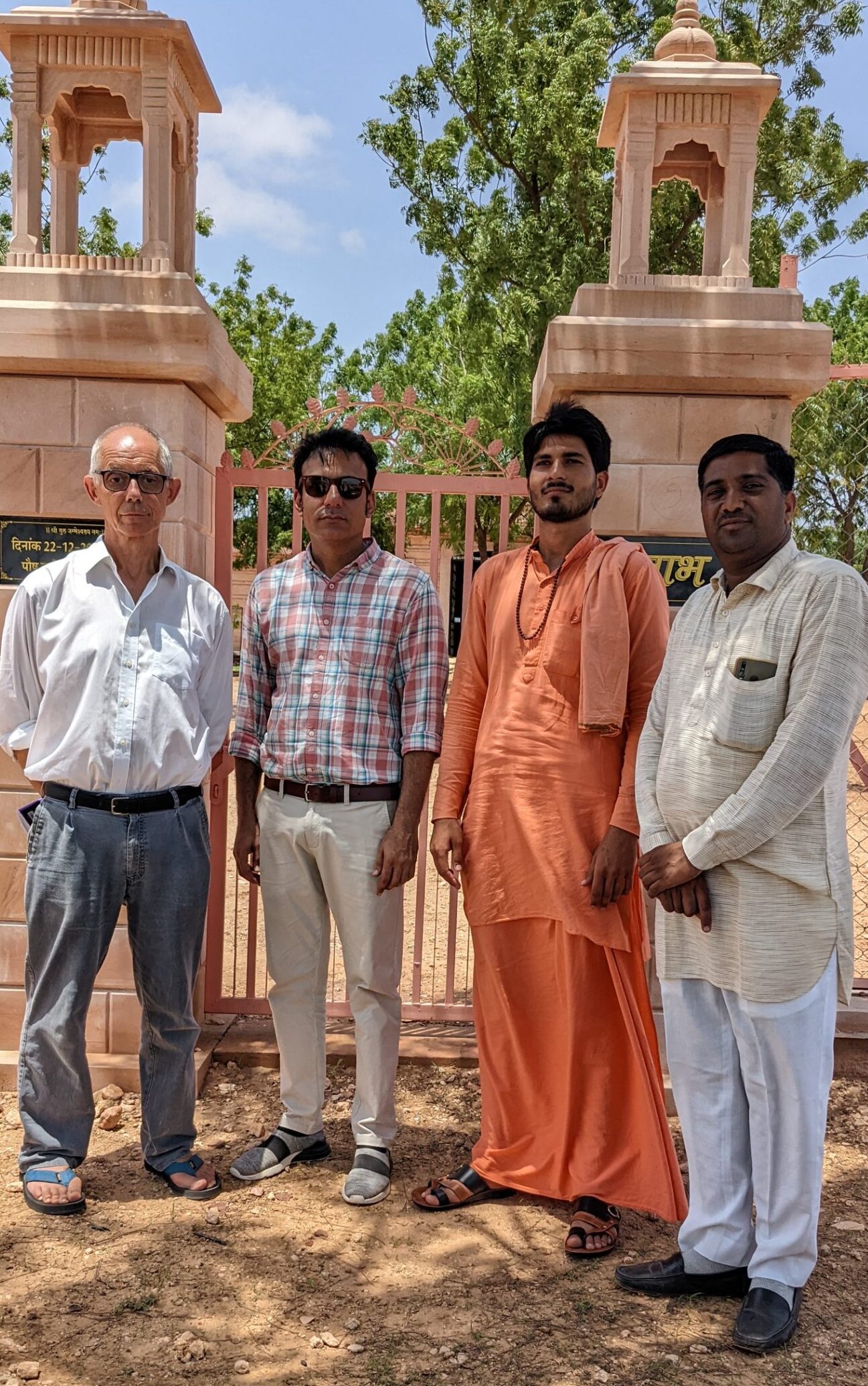
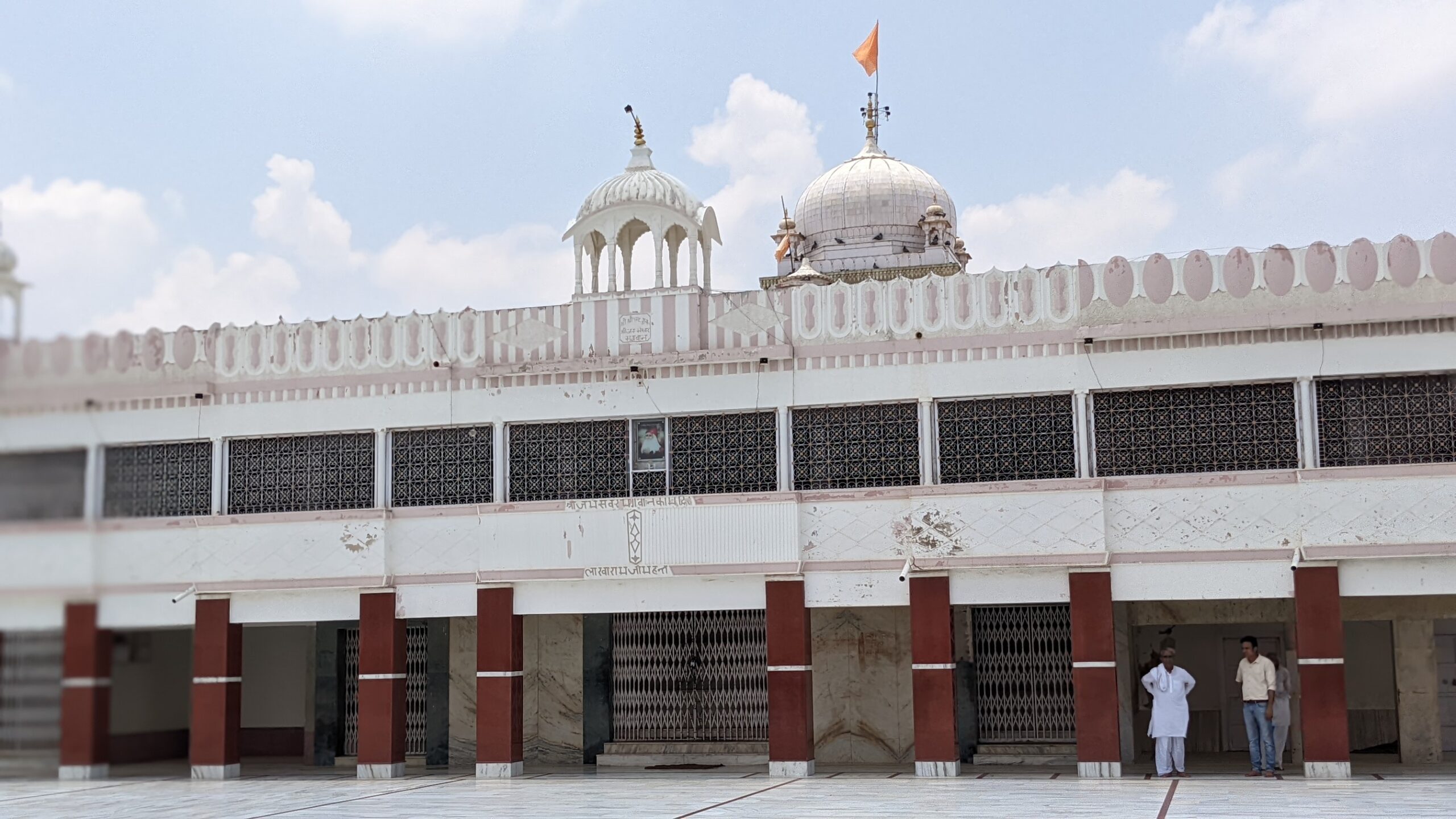
This priest, Swami Aatmanand, aged about thirty, assumed authority of this temple when its priest, his mentor, died two years before. That was in 2020, when I had last visited this hilltop site. Since then a whole new sathri, a pilgrimage house, has been built from pink stone. Sixteen of these sathris exist, built in places where Guru Jambhoji settled and taught for a time. This one is broad, with delicate carved columns, set back behind a deep courtyard of red sand, surrounded by a high fence. The priest came out through its gate to meet us.

His lunghi and overshirt were well-pressed, a scarf of lighter saffron draped over his left shoulder, and a string of orange beads hung around the open neck of his top. He is tall, his hair full and black, his beard trimmed, his nose aquiline, his gaze returning toward the distance even when talking to you. Such a good-looking man could stir excitement if he chose, but his is a celibate order and his movements are quiet, his presence serene. Does he notice young people, affected by climate change, growing more anxious?

‘No,’ was his simple response.

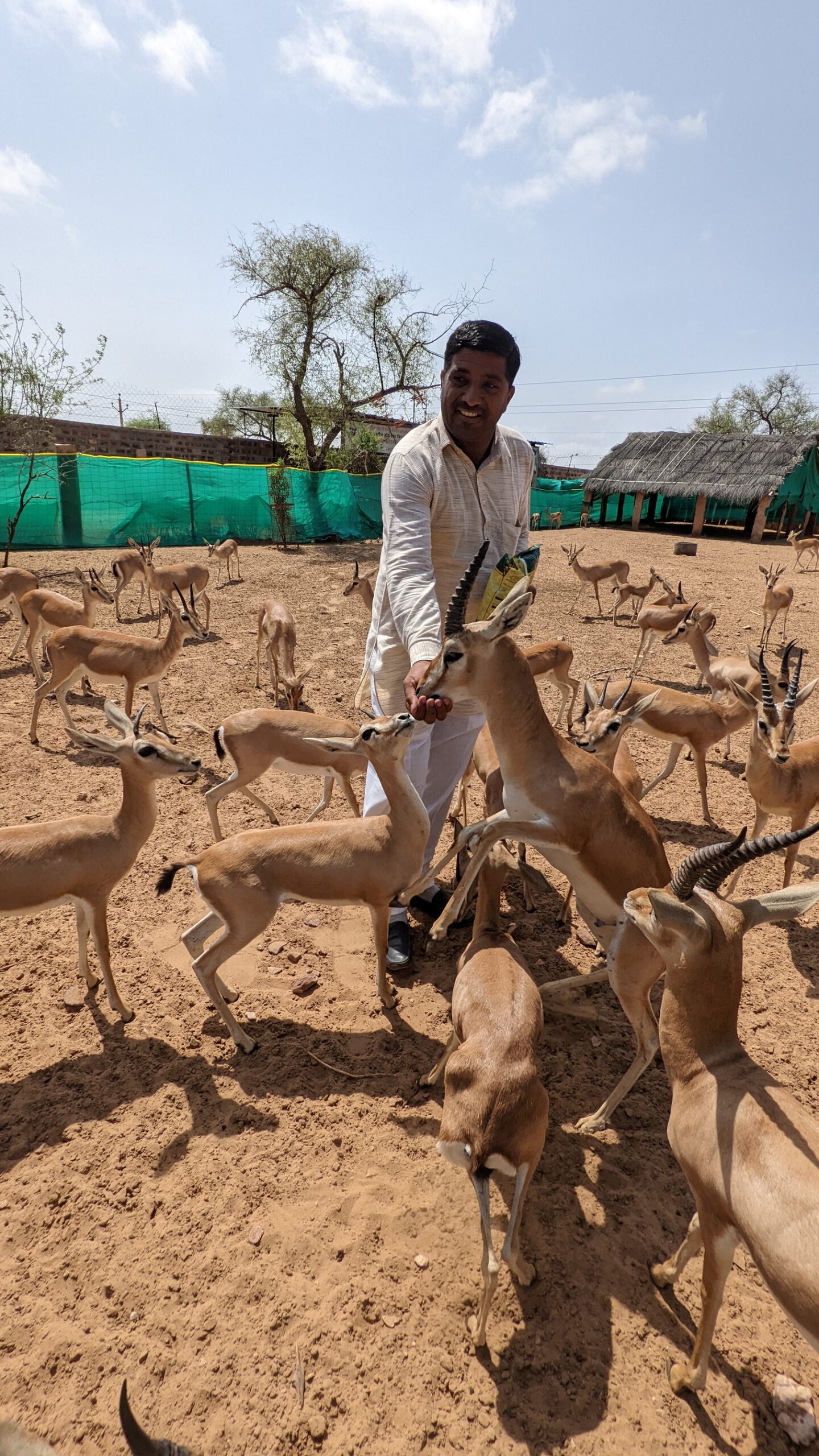
On my previous visit to this hill I encountered a flock of wild chinkara. Their heads were the height of my chest, and they approached warily, shivers of fear passing up from their necks to their ears, bowing their heads to show me their ridged horns, dancing backward on spindly legs. Today there are no such gazelles, just us people, but multiple acres of the desert plain below are surrounded by high red walls. A high formal entrance gate suggested that this was to an exclusive gated housing development. In a way it is, but the residents will be chinkara. This is to be a wildlife reserve where the chinkara are protected from roaming dogs. Businessmen in the village told funds were raised and the sanctuary was being built at the young priest’s suggestion. Swami Aatmanand clearly has power within his community.

He moves to the shade of a tree and shifts into storytelling mode. People have told me that Jambhoji’s teachings cannot be linked to the places where he delivered them, but much Bishnoi lore seems to be oral and localized.

In 1509 Jambhoji spent six months here. A principal character in the priest’s first story is the ruler of Jaisalmer, so I’ll introduce him with an earlier tale.

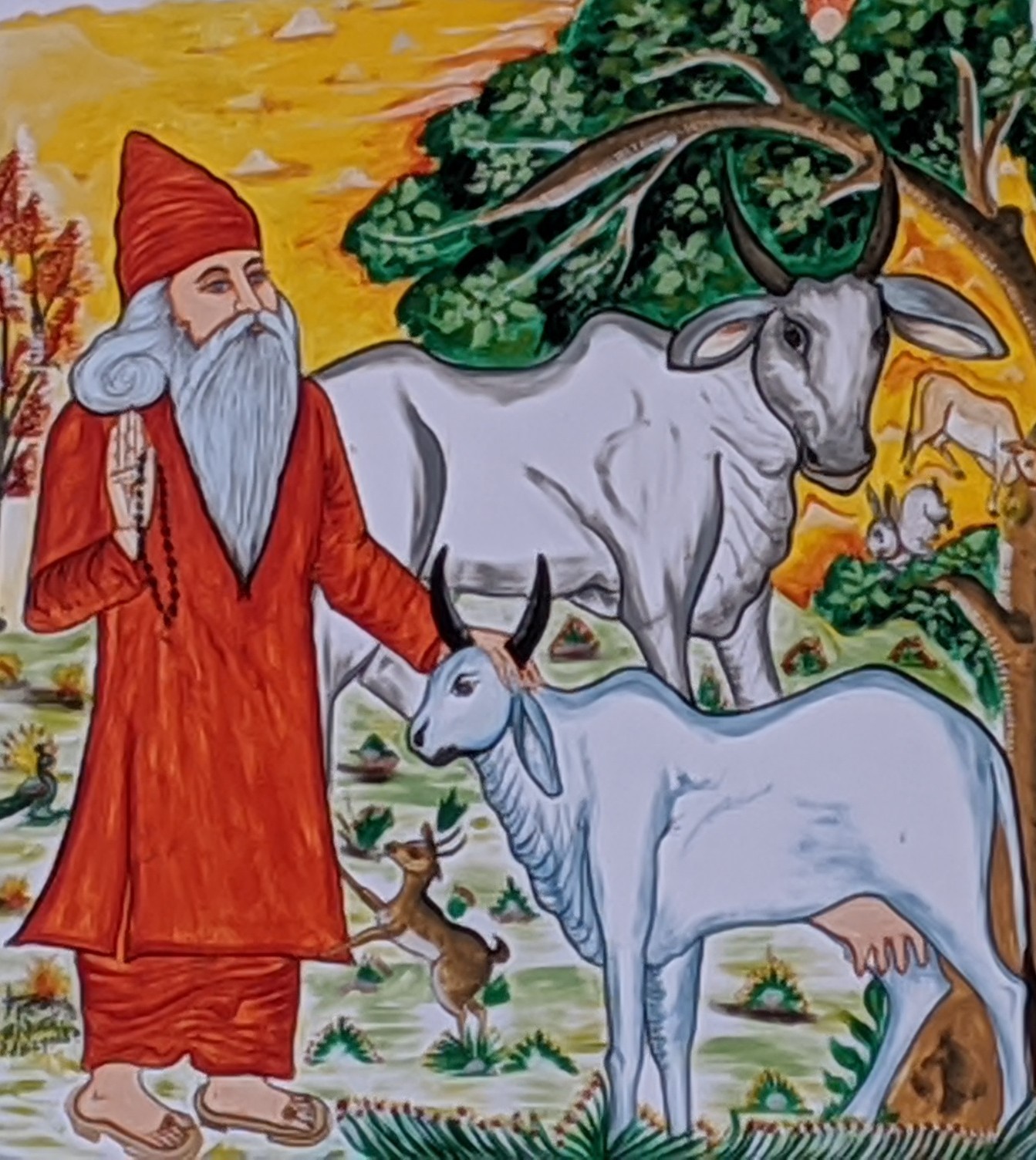
Guru Jambhoji

The ruler of Jaiasalmer, Rawal Jait Singh, was in the company of a prince and visiting the nearby city of Osian. His leprosy was advanced. The two men turned their noses northwest. A fragrance touched them. It was faint, for it had travelled forty-five kilometres,  a strong, unique scent they recognized as Jambhoji’s. They took to the road and followed it, climbing to where Jambhoji had taken residence on the Lohawat dune.

‘You’ve come a long way,’ Jambhoji said in greeting. ‘Let me feed you.’

The two men laughed. ‘Look at the size of our army, and all our vast retinue,’ the men said. ‘And we are used to dining off vessels made of gold.’ Perhaps the guru would like to join them?

But Jambhoji’s was not an idle invitation. He raised a hand and pointed to a distant dune. On its flank grew a tree.

‘Go to that tree’, he instructed two of his followers, ‘and dig a hole by its side.’

They did so, and soon their spades met the hardness of metal. They pulled the sand away with their hands and uncovered plates and drinking vessels all made of gold.

The men ferried the treasures back to the group, for whom food had meanwhile been prepared. A portion was placed on one of the gold plates and handed to the Rawal. He gathered the first mouthful between his fingers and pushed it between his lips. The meal was of vegetables, and it was as though the forces of life that powered growth inside the vegetables now powered through him. He took hold of his next mouthful. His fingers moved easily as he pinched at the food, and his lips opened without that sense of chapped soreness. The prince, his companion, left his own meal and stared at the Rawal. The signs of leprosy were gone.

‘How could this be?’ he asked. The food tasted no different to what they ate all the time, yet this meal had had such a profound effect of healing.

[In response, Jambhoji spoke the words since gathered as teaching numbered 94, in the collection of Guru Jambhoji’s teachiongs known as the Shabads. And to the Rawal, Jambhoji spoke words that were collected as Shabad 105.]

The meal was done, the gold plates and tumblers were cleaned, and Jambhoji instructed the two disciples who had dug them out from beside the tree were to now return them, hiding them once again beneath the sand. The followers did as told.

Well, almost.

The royal party had been so large, they had found so many gold plates. They selected two and buried them beneath a different tree. Later they could reclaim them and their families would be rich from their sale.

What might they do with such riches? Perhaps move to a different area where none would know them and question their sudden wealth. They could buy new land to pass to their offspring, their families growing larger with each generation.

Jambhoji of course knew, perhaps even before they had done so, that the men were stealing the gold plates. Actions, good and bad, have consequences. The disciples lusted after one future, but their acts of deception and theft committed them to another.

‘You will stay in this district of Lohawat all your life,’ Jambhoji informed them. ‘Your family will remain here, but it will not prosper and grow.’

Bishnoi families trace their lineage back through centuries to the time of Jambhoji.

‘The family is still here,’ the young priest told us, rounding off his tale. ‘And to this day, that family has very few members.’

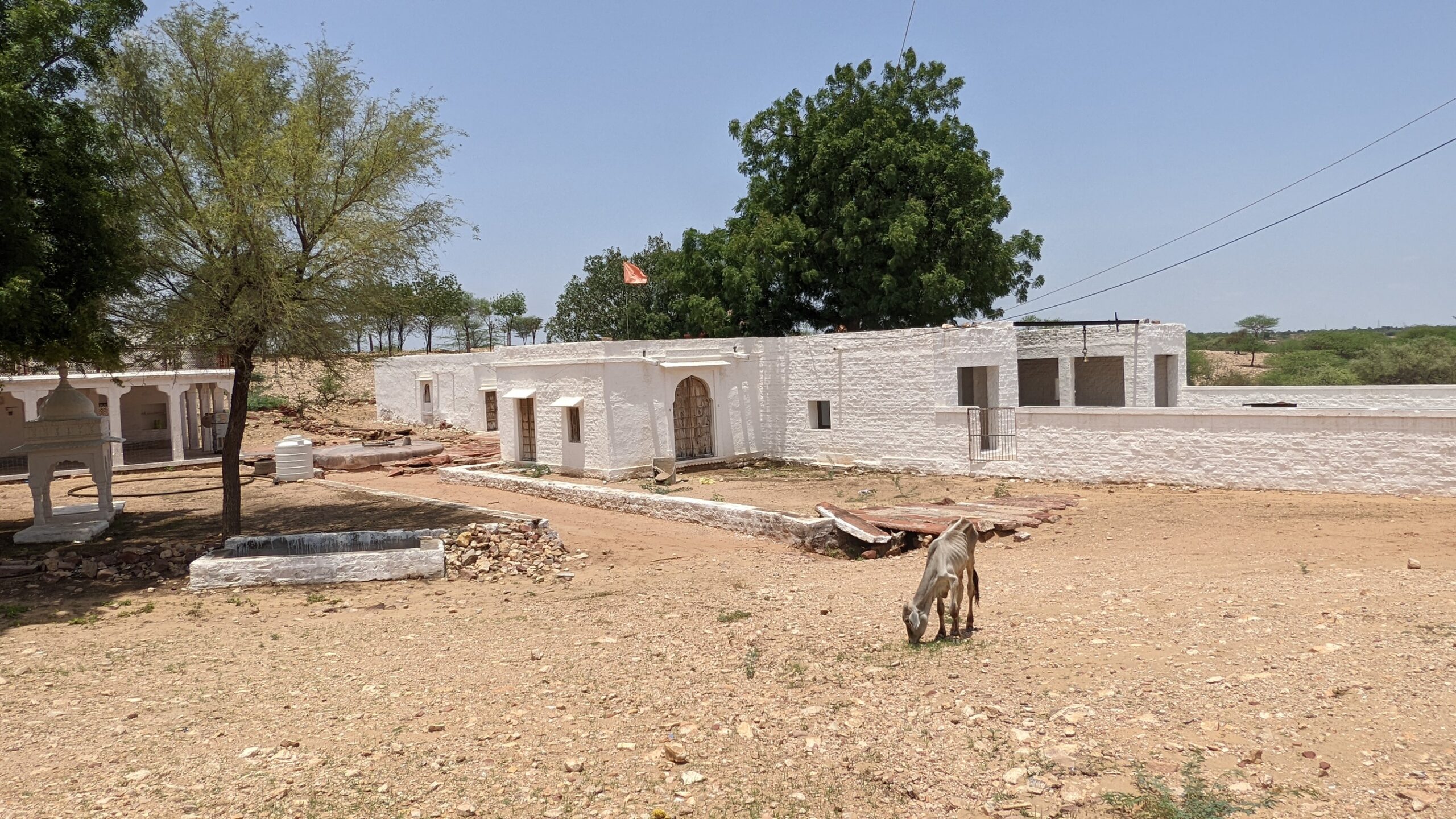
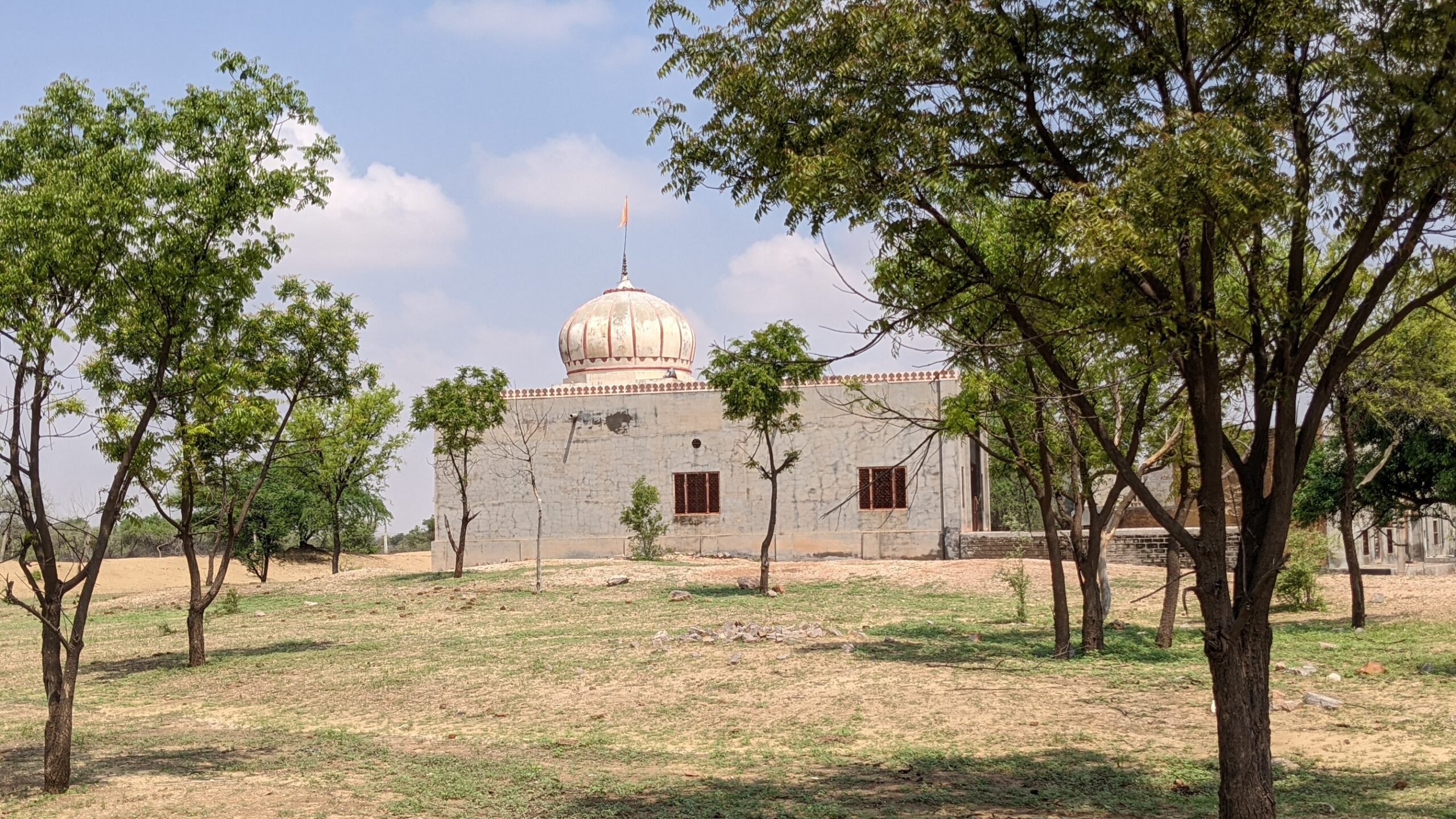
The temple, a simple white building dating back 350 years, is sited a little way down the side of the hill. Beyond it are steps leading down to an occasional pond. In Jambhoji’s day there was a well here, but it attracted bands of dacoits who stationed themselves here and terrorized the neighbourhood, and so the local community filled it in.

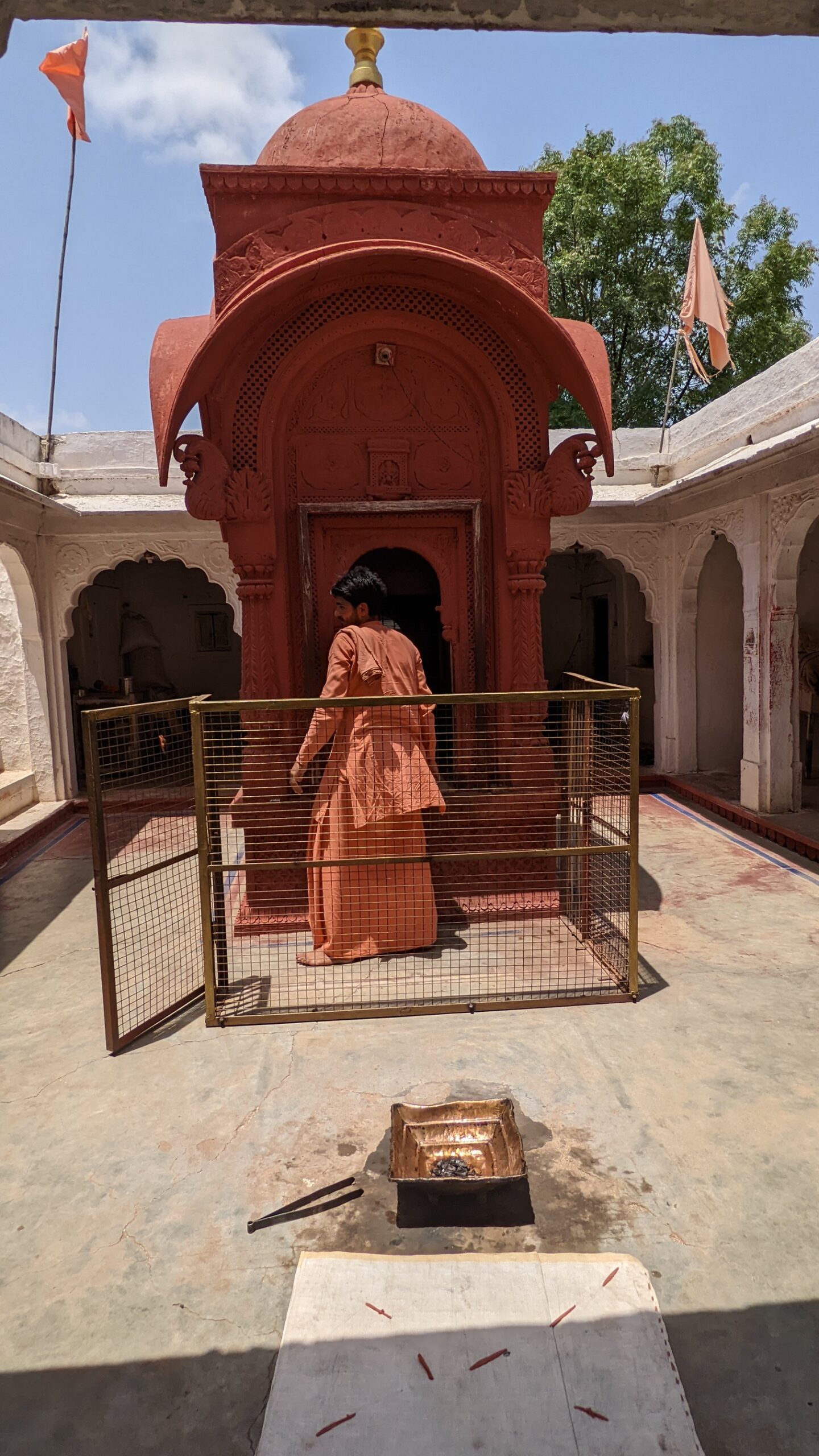
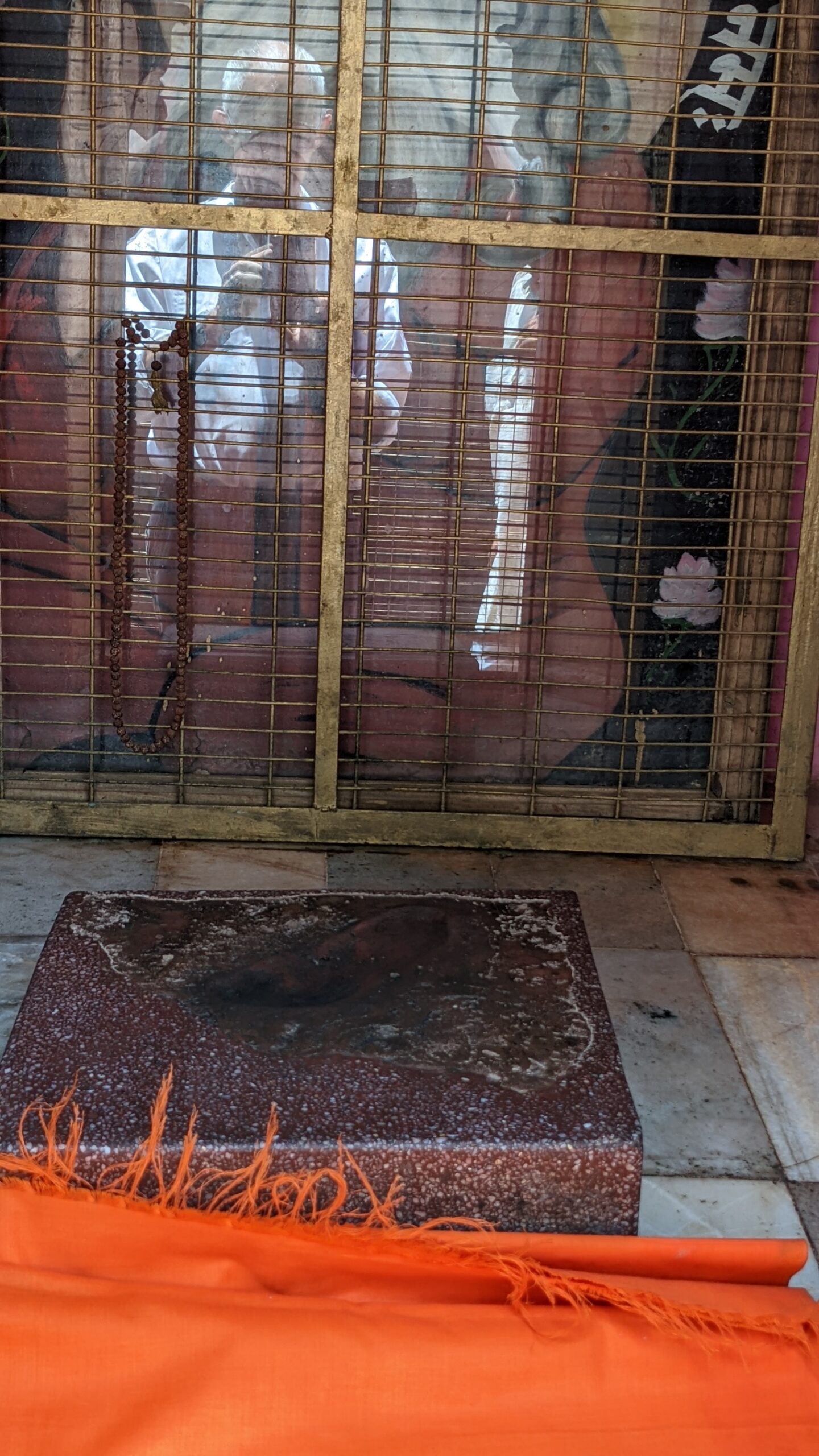
Treading gently in his brown leather sandals, the priest led us into the courtyard where he opened the door to a central shrine. Inside is a print of Jambhoji’s left foot, embedded in stone. The priest stroked it softly. Every morning they wash it, he said, which is why it is fading away.

The Queen of Lalasar once came here, he told us. She was looking to become pregnant. After drinking water from this imprint of Jambhoji’s foot she conceived a baby boy and paid for the building of the temple in gratitude.

The imprint of Guru Jambhoji’s footstep, Lohawat

The story of the Queen of Lalasar and her yearning for a baby is told differently in the temple at Lalasar. She went there, prayed to Jambhoji, and promised to pay for the creation of a pond if her wish for a child was granted. When the baby was born she forgot her promise. At thirteen her young son died. Taking this as judgment for not having fulfilled her pledge, the queen sold all her belongings and donated the proceeds to the temple. They were used to build a pond.

Two different stories. ‘Which one is true? I asked the young priest at Lohawat.

‘I believe this one,’ he said.

(And indeed both could be true: the Queen drank from Jambhoji’s footprint at Lohawat, and honoured her promise to fund a new temple there, but forgot her pledge elsewhere that she would build a pond. She had spoken falsely. Her action had consequences.)

What is the young priest’s message for the world?

He thought for a while. ‘Follow Jambhoji’s teachings,’ he said. ‘Do so for generation after generation, and the world will be a beautiful place to live.’

The Sathri at Lohawat, with a grazing chinkara

[For more on the Bishnois, please read my MY HEAD FOR A TREE (here’s a review)

Letters from Cruising

February 18, 2025

“A ravishing collection, remarkably wide-ranging in subject, mood and tone, each story exquisitely crafted. A complicated young man embarked on a romantic adventure and diving into deeper water than he can safely navigate. A clergyman shedding his faith as he retraces the footsteps of St. Paul. Several linked tales chronicling lovely Arnold’s wondrous, ultimately bittersweet wet dream of a life. A boldly imagined “missing” scene from Melville’s Billy Budd. These stories explore the cadences and crises of gay men’s lives with fine, empathetic insight. Goodman’s attention to detail often combines with verbal felicity to memorialize even the most ordinary moments. Powerful and affecting work.”
Paul Russell, author of Immaculate Blue

“Martin Goodman’s wild, irreverent and fetching stories pulled me in. I was especially taken by his Melvillian outake on Billy Budd, the fine last story in this collection, which is moving and weirdly plausible.”
Jay Parini, author of The Passages of Herman Melville and Borges and Me

My Head for a Tree

February 18, 2025

The Extraordinary Story of the Bishnoi, the World’s First Eco-Warriors

Meet the Bishnois, the world’s oldest sustainable community – with a foreword from Peter Wohlleben, author of The Hidden Life of Trees

‘Sensitive and engaging … I hope everybody reads it’ Brian Eno

SPECTATOR BOOK OF THE YEAR 2024

With a foreword by Peter Wohlleben – “I was electrified – This book, thrilling to the last page, fills a gap in the environental debate. It can offer inspiration to many readers who wish to concentrate on the truly important things in life … What an enormous contribution Martin Goodman offers by bringing this culture and religion closer to us.”

How much can one love a tree? Rajasthan, in northern India, is home to the Bishnoi, a community renowned for the extreme lengths they go to in order to protect nature: Bishnoi men and women have died to defend trees from loggers and wildlife from poachers.

Writer and conservationist Martin Goodman, one of few trusted outsiders, relates the history of the Bishnoi, and asks what a world facing climate change and natural disaster can learn from a 600-year-old sustainable community leading an existence in delicate balance with nature and under threat from rapacious modernity.

My Head for a Tree offers a timely reflection on indigenous, community-based activism and how we might adjust our lives to fight for the natural world.

“The story of the Bishnoi – the first true environmentalists – is important, inspirational and humbling. My Head for a Tree is essential reading for all those who care about our magnificent planet. Utterly fascinating.”

Some reviews:

Martin Goodman’s ‘My Head for a Tree’: A tribute to Bishnois & fierce love for nature – The Tribune

Review: My Head For A Tree by Martin Goodman – Geographical

And in The Hindustan Times

The Bishnoi Temple at Jangloo, Rajasthan

February 17, 2025

An online addition to My Head for a Tree

Journeys between the main Bishnoi temples wind through narrow Rajasthani lanes and head off-road across desert. Heading from Lalasar to the village of Jangloo, a villager climbs in and offers directions, and commentary, from the car’s front seat. He laments the lack of camel’s milk and all its health benefits. The camel eats what other animals don’t, including the fog grass which grows like green steam clouds by the side of the road, so its milk is unusually nutritious. Camels do still pull carts through these streets though. And we pass one pulling a tire, switching from side to side, being trained to pull straight by two men.

This is village India, but the man who leads us around Jangloo lives an hour away, in the city of Bikaner. Trucks on Rajasthan’s highways, decorated as gaily as carousel rides, often belong to Bishnoi families. And are likely as not made by Tata Motors. Rajaram Ji owns Tata truck dealerships, along with motorcycle suppliers and the gas stations that operate from their forecourts. His hair is dark grey and oiled back across his head, his face marked by laughter lines.

The small Bishnoi temple at the Sathri. near Jangloo, Rajasthan

He shows me around a sathri, one of those sixteen temple-and-accommodation complexes built to house pilgrims in places Guru Jambhoji once stayed. It is remote, and a work in progress. Extensions are half complete, rubble strewn around. Its custodian wears a blue checkered dhoti, his round belly taut above it. He and Rajaram greeted each other like old friends, but now words get heated. The place is unkempt; it could be swept, tidied. What are we paying you for?

‘I have ten cows to look after,’ the man laments. The cattle are grazing placidly between the trees. ‘And an old man at home I have to do everything for.’

The shrine to Guru Jambhoji in the temple at Jangloo

Inside the temple, a lamp is burning in front of Jambhoji’s shrine. Follow Rajaram’s eyes around the building’s structure and you keep noting areas for repair.

Rajaram Ji at the lake dug by Barsingh, with Ganpat Bishnoi

The land is planted with saplings. As we prepare to leave the site, Rajaram puts all construction worries to the side, raises his arms into the air, and tilts back his head to gaze into the sky. He turns a half circle and then points toward a young khejri tree. ‘Jambhoji did not need a palace,’ he says. ‘His palace was a tree.’

He leads the way to a lake, with a temple on its bank and changing rooms for when Bishnois come here to bathe. The lake is man-made, the responsibility of Barsingh, a disciple of Jambhoji’s, and a miracle is associated with it. On a nearby sand dune, a wandering holy man appeared to a shepherd and told him to spread the alert. Heavy rains were about to come, people must gather and clean the edges of the lake, so the cow dung deposited there wasn’t swept into the water. People knew the signs of oncoming rain, the sky was clear, they expected nothing, but even so they rallied in the sunshine and made sure the long perimeter of the lake was swept clean. As they finished, the downpour came.

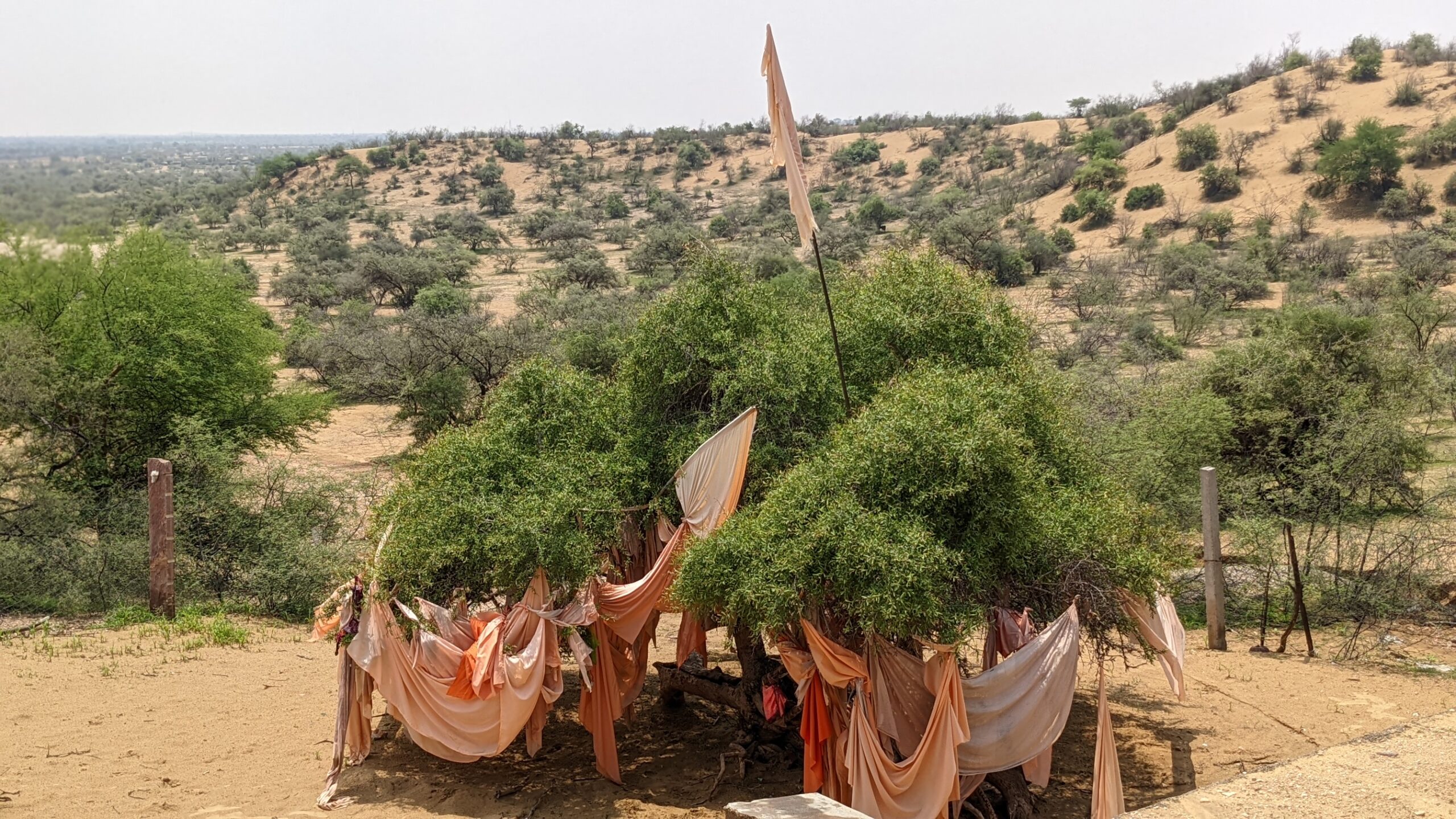
The implication is that this sadhu was an apparition of Jambhoji. More historically, Jambhoji is known to have sat beneath a kankeri tree on the dune where that holy man appeared. The tree is still standing, thickly adorned with saffron flags.

The kankeri tree on a dune near Jangloo, under which Guru Jambhoji once sat.

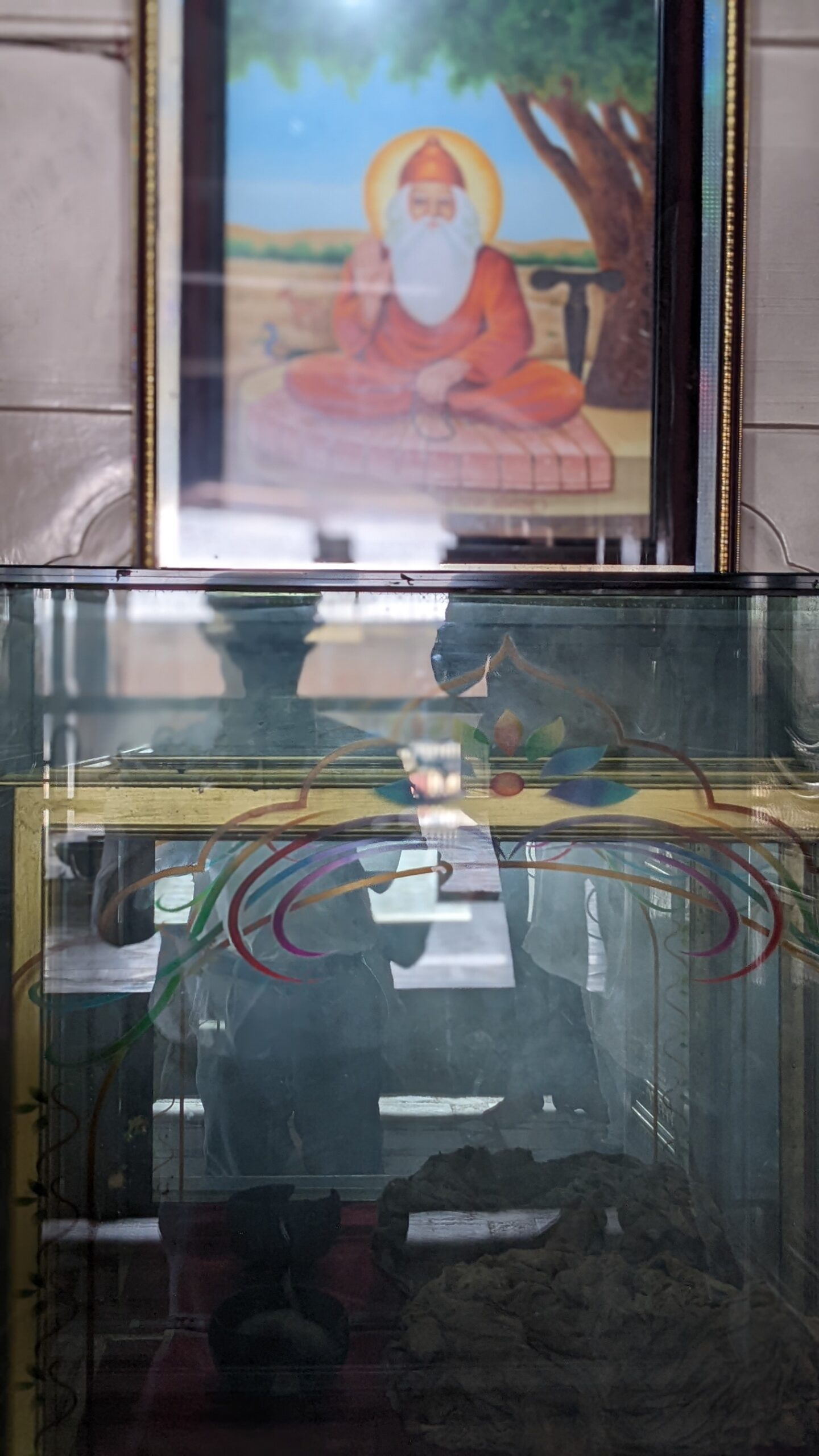
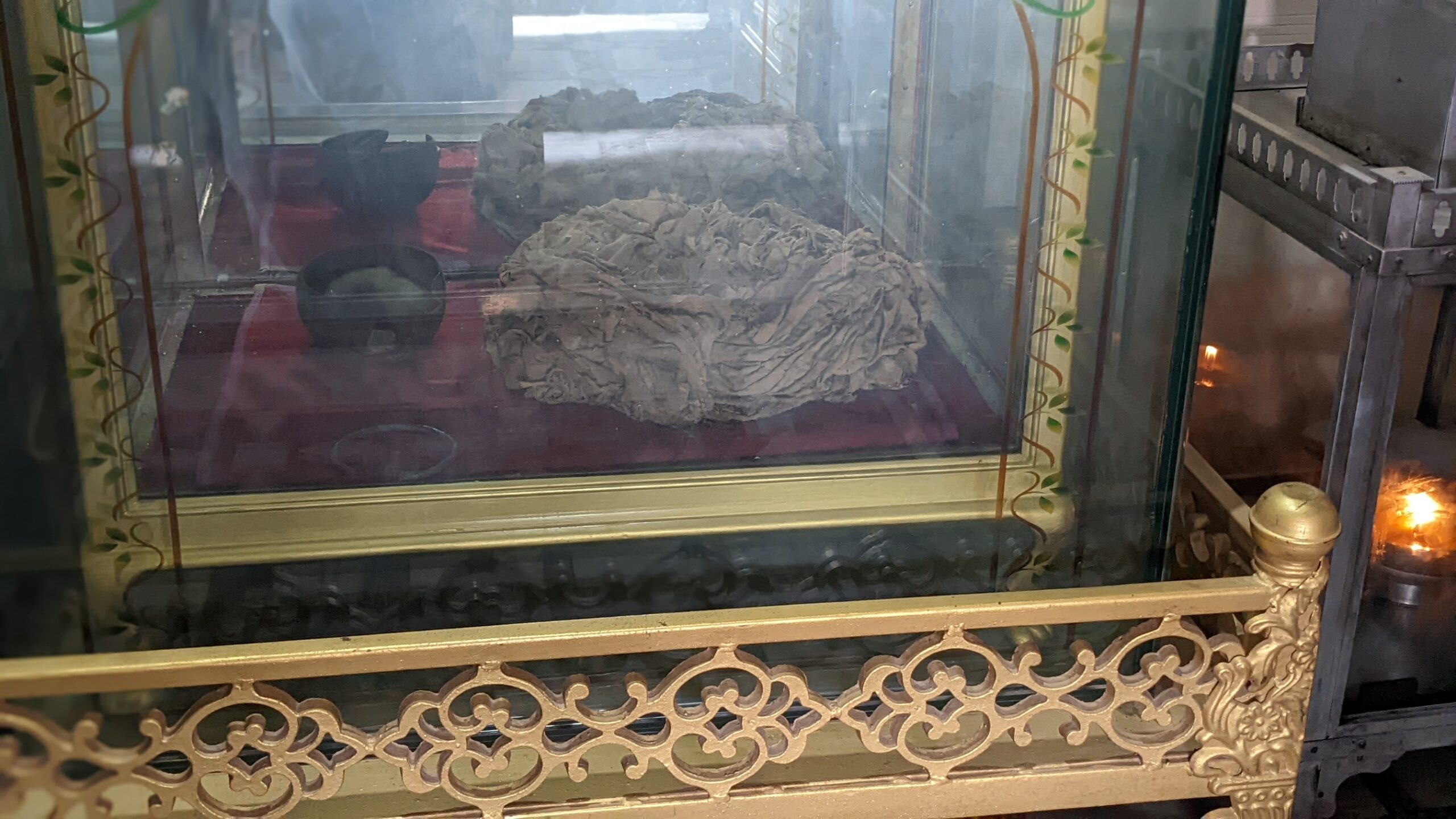
The most prized relics of Jambhoji are held in a glass case at the heart of the temple in Jangloo village. The image of Jambhoji hangs behind it, the man cross-legged beneath a tree, his right hand raised in blessing. He is wearing his conical saffron cap and the kurta, the loose saffron overshirt, seen in all such images, and this kurta and cap are in the glass case. Beside it is the ladle that was also once his. They were brought to the town by one of his disciples and have rested here since.

The holy relics of Guru Jambhoji, in the Bishnoi temple at Jangloo

The kurta has been spiralled liked a turban, the fabric turned brown and fragile, the cap hidden beneath it.

‘It used to be hanging,’ Rajaram explained. ‘Then we became aware of its condition and closed it into a case.’

I wonder if the kurta had given them any sign of the height, the size of Jambhoji, before it was closed away, but Rajaram’s ‘we’ had given a sign of the long tradition of which he is a part. The relics were encased in glass two hundred years ago. The clothes would crumble to dust if disturbed.

Across the way from the temple, beyond a village square of packed earth, is the dharmasala, the community hall. ‘Take therapy,’ Rajaram suggests as we pass a cow in the square. ‘In the USA people pay for this therapy. It is very good.’ And he sweeps his hand firmly down the cow’s flanks, long soothing gestures.

He’s right. Sweep your hand over warmth, a hide of hair packed close to muscle and strength, connect your human body to a beast that is so much larger yet placid and unquestioning, and it is a shift out of the bother of maintaining self-importance.

The community building has several rooms built along a covered corridor. It’s free to all who wish to stay here. We settle onto beds for discussion.

How easy is it for Rajaram to follow his Bishnoi practices in the city?

He starts by speaking of Amvasya Day, the Bishnois’ monthly sabbath. On the day the first new moon will appear, people stop all work and fast from sunrise to sunrise. That is when this temple becomes busy, as it also is on the two packed days of its annual festivals.

And your dealerships? I ask. They are linked to the wider, non-Bishnoi, city economy. Do they close for this monthly holy day?

A slight shake of his head, but then, ‘No construction work, no agricultural work,’ and of course domestic work can relax for the hours of fasting.

Rajaram then tells me how before his workday in the city he rises at 4am every day, first takes his shower, and then does his havan and ghee fire ceremony before doing his chanting.

The twenty-nine Bishnoi rules include never lying.  ‘In my business, I never lie. At the petrol pumps of my stations I never charge more than the dial shows, and instruct my people to do the same.’

How does never telling a lie work, when he is in competition with other businesses?

‘They are struck by my honesty and it spreads. They become honest themselves.’

The Bishnoi temple at Jangloo, Rajasthan

ClientEarth and China: using law to save the planet.

February 29, 2024

(In 2022 I revised the award-winning 2017 book Client Earth for Spanish publication. The text was heavily revised and updated, and I present the chapter on China here in its English version, updated as of February 2024.)

Back in 1992, the China Council for International Cooperation on Environment and Development (‘the Council’ or CCICED, pronounced ‘sea-said’) was established by the State Council of the Chinese government. Its mission is to foster cooperation in the areas of environment and development between China and the international community. An equal proportion of Chinese and international members are ‘chosen for their experience, expertise, and influence’.

‘For China to develop well,’ the Council’s Chair, Zhang Gaoli, told the Council’s AGM in 2014, ‘we have to draw modestly on all the best practices around the world, and to learn from all the civilizations around the world. Only by doing that can we develop well.’

Bands of Chinese officials went roving to find global leaders in public interest environmental law. In the summer of 2014, one panel of Chinese policy advisers reached Brussels. The group was headed by Wang Yuqing, the former Deputy Environment Minister of China, and included a member of the National People’s Congress, China’s lawmaking body.

They were guided by a Dutchman, Dimitri de Boer, who ran the EU-China Environmental Governance Programme. ‘They came in with specific environmental laws that were being drafted,’ Dimitri recalled, ‘and they told me some of the key sticking points and points of controversy that they wanted to have an international sounding board for. I brought in experts like James Thornton to answer those questions.’

James Thornton, President and Founder of ClientEarth, cut short his summer holiday and trundled by train from southern France. There was no clear reason to do so. Governments in Europe were largely antagonists in the environmental arena; the likelihood of China seeking genuine dialogue with a representative of a European NGO was slim. Still, the delegates had come a long way from China, and James headed a Brussels law office. Some show of welcome was polite.

As James spoke to the assembled group, he saw some faces become alert. He had set up and run public interest law programs in the USA and battled to instill them into Europe. He spoke of bringing a hundred cases to enforce the Clean Water Act in US Federal Courts. ‘They were intrigued,’ James said. ‘And then I explained how those cases had a deep, ulterior motive. By doing the government’s work for them single handed, I meant to embarrass them into resuming the work themselves. That’s what happened. How the delegates loved that; they laughed and laughed. It perfectly fit the Chinese notion of “face”, shaming the government into doing its duty by doing it for them. And then when they stopped laughing, their questions started. Real and good questions.’

Wang Yuqing explained how they were eager to get more NGOs going in China. Could such NGOs work if the government supported them or would they lose their independence? How would that situation work in the West? The government’s study of how to kickstart a new generation of Chinese environmental NGOs was clearly in earnest.

The delegates returned to China. Shortly afterwards, an invitation from the EU-China Environmental Governance Programme arrived in James’s London office. Would he fly to Beijing and share his experiences with judges of the Supreme People’s Court?

This was for September 2014. China’s revised Environmental Protection Law was about to take effect, and a judicial interpretation was urgently needed to give courts a framework for how to deal with cases brought by NGOs.

Humans have progressed from a stone age civilization, through an agricultural civilization, and then an industrial civilization which is at the end of a 300-year run of unsustainability. China has decided to articulate and force into being the next era of humanity’s planetary existence. It has pledged to bring into being ‘ecological civilisation’.

The phrase was coined by the agricultural economist Qiang Ye in 1984 and became the substance of rigorous debate in Chinese academic circles. That debate retrieved the concept from Ancient Chinese religious and philosophical discourse. For example, 2,500 years ago, Laozi wrote: ‘Man takes his law from the Earth; the Earth takes its law from Heaven; Heaven takes its law from the Tao. The law of the Tao is its being what it is.’

‘Ecological civilisation’ entered politics in a report to the 17th National Congress of the Chinese Communist Party in 2007. The phrase became enshrined in the Chinese Communist Party’s Constitution in 2013. For the current leader, Xi Jinping, the forging of an ecological civilisation is a cause ‘benefiting both contemporaries and future generations’.16

In a parallel shift of focus, in October 2014 the Communist Party pledged to establish the ‘rule of law’ by 2020. China’s foremost environmental lawyer Wang Canfa has remarked, ‘In the past 30 years, China’s modern environmental law has developed from nothing to an independent and important section of China’s law system.’19

The task of ushering in an ecological civilisation is monumental. It needs all the new laws going, and every enforcement mechanism. Lawyers and judges need training, and citizens need fair and generous access to information and justice.

James flew to Beijing alongside two senior European judges. Their objective? To address a full day’s meeting at Beijing’s Grand Hyatt Hotel. James’s particular task was to share his wealth of experience with public interest environmental litigation.

The meeting turned out to have a dual purpose. The morning session focused on judicial interpretations for the Supreme People’s Court. In the afternoon, attention switched to members of the National People’s Congress. They attended because they were finalising an amendment which would allow prosecutors to bring public interest cases against local governments.

‘It worked out really well,’ Dimitri recalled. ‘Senior representatives from both the Supreme People’s Court and the National People’s Congress Standing Committee met James, to discuss how they should set up the system for environmental public interest litigation and a trial for public interest litigation by prosecutors. James was the star of the show. Two legislative documents were issued in the last months of 2014, incorporating the key recommendations James had made — particularly regarding setting up the rules for cost bearing in such a way that NGOs would only lose a little if they lost their case. It’s hard enough to build a strong case, and it’s unrealistic to expect that an NGO would be able to afford high court fees or the legal costs of the defendant.’

Soon after, in February 2015, James secured a meeting inside an impressive room in the Supreme People’s Court building, with one clear agenda item: could ClientEarth set up an office in China, and start formal cooperation with the Court? A chandelier cast light onto a vast white and brown marble table, which was surrounded by white leather chairs. James and Dimitri de Boer sat with a translator on one side, and a grouping of Supreme People’s Court judges and advisers on the other.

Chief among these was Wang Xuguang. He can be utterly charming, with a Buddha-like sense of beneficence and calm, but you don’t mess with Judge Wang.

‘We talked for an hour,’ James said, remembering the encounter. ‘Judge Wang gave whole hearted approval of ClientEarth’s plan: following the end of the EU-China Environmental Governance Programme, Dimitri and the project team would start a ClientEarth office in Beijing, and continue the judges trainings they had provided alongside the Ministry of Environmental Protection.

‘James, please do your work in China,’ the judge said, ‘Carry on with these trainings, and do more of them, and we’ll be extremely grateful. You can start by training us, the environmental judges in the Supreme Court, and continue to train the thousands of environmental judges around the country.’

‘James made a very strong case about one way cost shifting to the Supreme Court,’ Dimitri remembers of that September training day. ‘ We can look at feedback from them. It had an effect. Some of the Supreme Court people were very candid about telling James which areas they followed up on and built into their system, and were very grateful to James for a bunch of things he said.

‘It’s clear that the Supreme Court’s very conscious of the difficulties that NGOs face in bringing such cases — particularly financial but also in terms of their lack of capacity. Their judicial interpretations include clauses that protect the NGO from excessive costs and allow them to get cost recovery.

‘Also, if they come up with a case that seems compelling but for which they don’t have very adequate evidence, judges will go out and physically supervise the evidence collection. If the court takes the evidence, who are you to argue that the evidence is wrong?’

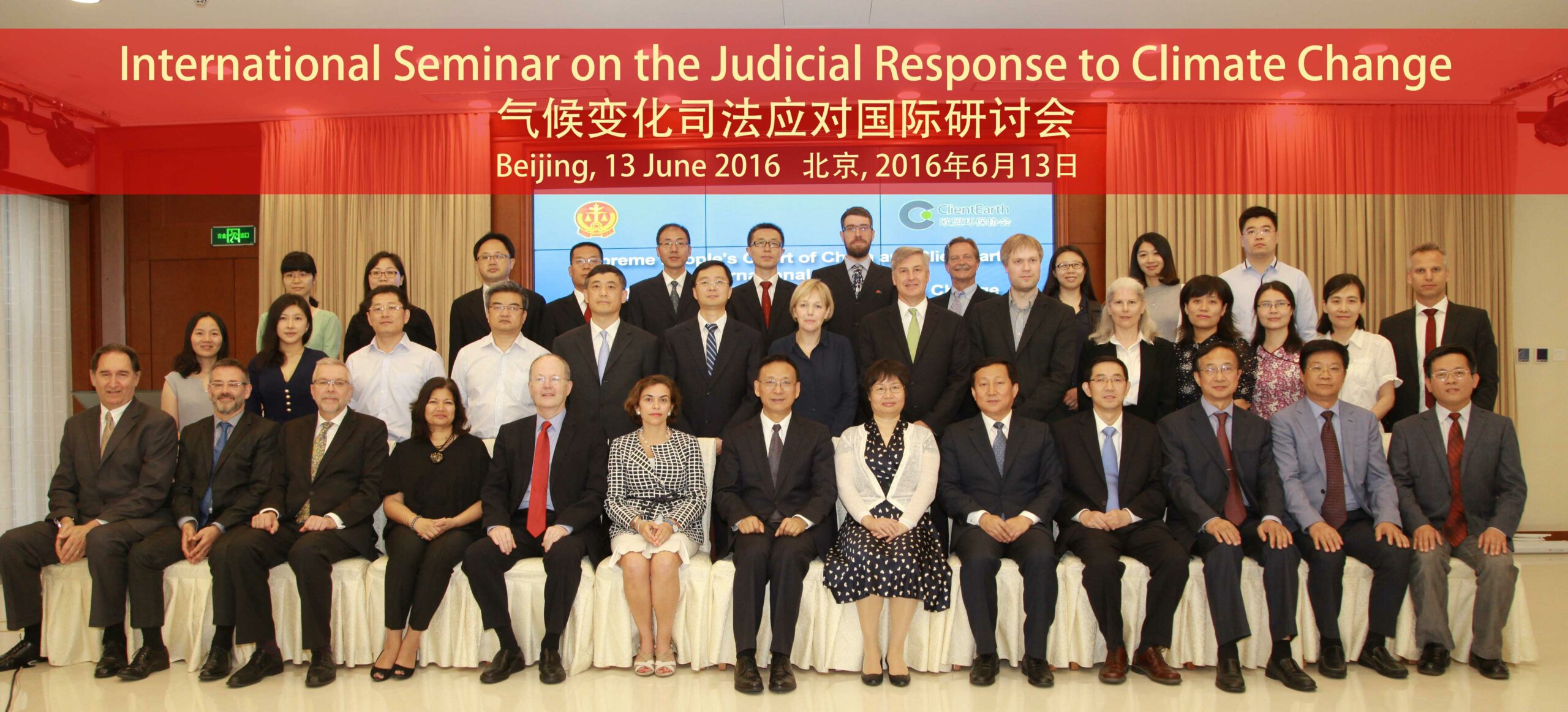
In June 2016, the Supreme People’s Court called three hundred environmental judges to Beijing for their annual training, with ClientEarth as an official partner. James flew in and added the sum of his experience, joining as a lecturer and bringing in other Western experts. It marked the first time Chinese judges were trained on climate change.

James Thornton and judges from the Supreme People’s Court of China, at the close of the 2016 ClientEarth seminar inside the court.

Earlier that week, James co-led a seminar on climate change litigation in the Supreme People’s Court for its members. That seminar, too, was a first – no foreign experts had ever been invited to a seminar held inside the Court’s building.

After the training, when speaking to the three hundred assembled judges, Judge Wang made a point of saying that climate change litigation, broadly defined, should become a priority for the Chinese judiciary.

James became a member of the China Council for International Cooperation on Environment and Development (CCICED). ‘The way I think of the CCICED,’ James says, ‘is as the environmental think tank for the State Council and Politburo. It develops ideas by combining the efforts of Chinese experts and Western experts. It is a powerful formula.’

A new law came into effect in 2017 which required international NGOs to be registered, and have a government sponsor.  ClientEarth became the first European NGO to get an official registration sponsored by the Ministry of Environment. By 2021, as his Beijing team kept growing, Dimitri was preparing for his third office move.  They had trained thousands of judges and prosecutors. What have those prosecutors been doing with their new skills and power?

Qiu Jinghui had been a prosecutor for all of his career. He became specialized in preventing government corruption, and the work suited him well. In July 2015, he applied to join a new team which would be dedicated to public interest litigation.  Thirteen provinces would conduct trials, where local prosecutors would bring environmental public interest cases, primarily against government. Two years and thousands of cases later, the trials were considered so successful at getting local officials to follow environmental laws that President Xi Jinping personally endorsed the establishment of permanent public interest litigation departments in the Supreme People’s Procuratorate, and around the country.

Qiu grew up by the sea in Fujian Province, and fondly recalls catching shellfish as a little boy. But all that changed during his college years. ‘Economic development was the overriding priority. Several big bleaching and dyeing houses moved into my town, and a few years later the coastal water was so polluted that it was devoid of life.’ Compared to those from northern China, people from Fujian generally have an international mindset. With its many fishermen and seafaring traders, there is a strong diaspora from Fujian around the world.

Over several years, through international seminars, trainings, and overseas study visits, ClientEarth cooperated with the Supreme People’s Procuratorate. Not having an environmental background, Prosecutor Qiu welcomed their support. He became a deputy in the national team that oversaw the public interest prosecution work. In that capacity, he led the effort in protecting the Yangtze River, China’s longest river, at the core of the most developed region. He also supported the work of the Central Environmental Inspections, powerful new teams formed of environmental officials and anti-corruption inspectors, who dig up environmental problems of provincial leaders and large state-owned enterprises. And he trained the thousands of prosecutors newly assigned to protect the environment.

In October 2019, he joined a ClientEarth delegation to the Netherlands and Belgium. One of the delegation members spoke at a conference of environmental prosecutors from all over Europe. The European prosecutors were surprised to hear that their Chinese colleagues could bring cases against environmental violations by government – that would be unthinkable in their countries.

Qiu Jinghui considers the role of NGOs and prosecutors to be highly complementary. ‘Environmental NGOs have strong environmental knowledge and are good at discovering environmental problems. The prosecutors have much more resources and are in a position to bring cases against government departments. By working together, we can be way more effective.’ 

He describes a case in the island province of Hainan, where a ship had been illegally dumping waste into the ocean. Eleven times over several weeks residents had called a hotline, but the local government department in charge kept telling them they couldn’t find any evidence of wrongdoing. The local public interest prosecutors were monitoring the hotline and grew suspicious. Why the repeated calls and lax reaction from government? So they went to the site and found a makeshift dock, but no ship.

A few days later, the prosecutors secretly went back with aerial drones, and obtained video footage of the ship dumping a huge load of waste in broad daylight. The ship was impounded. Following a rigorous assessment and court case, the judge ordered the defendants to out right the damage they had caused and pay over 9 million RMB (1,3 million USD) in environmental damages.

With his love of the sea, Qiu is particularly pleased with this example of public interest prosecutors doing their work. ‘Nobody wants to see the ocean being degraded like that,’ he says. And he hints at possible collusion with local government officials. “The case is important because it led us to the illegal industrial chain and the ‘unspoken rules’ in the industry which we must rectify. When it’s all wrapped up we should really make a movie out of it!’

2020 was a record year for the public interest prosecutors – over 80.000 environmental cases were brought around China. ClientEarth received a letter embossed with the name of the Public Interest Prosecution Department of the Supreme People’s Procuratorate. People fear such letters. What had they done wrong? Fear switched to relief as the letter unfolded. The Procuratorate were expressing appreciation for all the cooperation since those initial trials of 2016, and for the trainings on important topics like biodiversity and climate change. This cooperation is unique in China – it is the only example of an NGO working so closely with the Procuratorate. ‘We look forward to seeing you remain committed as you always do to supporting the development of China’s procuratorial PIL [Public Interest Law] system,’ the three-page letter concluded. ‘Let us join hands to build the world into a better place!’

In 2018 China’s Ministry of the Environment established an international coalition to work on greening the Belt and Road, and invited James Thornton of to join as a governing board member. They were now ready to conduct joint research on an environmental standard for China’s overseas investments.  In earlier discussions James had mooted a ‘traffic light system’ and the Minister now called for such a system to be set in place, where proposed projects would be rated green, yellow, or red, based on their environmental and climate impacts. Coal power would be in the red category, which would effectively put them on an exclusion list. The effort got a further boost in April 2019, at the second Belt and Road Forum, when President Xi Jinping said that the Belt and Road must be “open, green and clean”.

The key lever for greening China’s overseas investments are the state-owned financial institutions. There are thousands of projects and developers, but only a handful of financial institutions behind them. When they go green, the whole Belt and Road goes green. The financial institutions would be the key target group for the traffic light system.

By late 2020 there had been remarkable progress in developing the traffic light system. It was the one project that kept going at full speed, despite COVID-19. Everyone realized the critical importance of having a system to prevent environmentally harmful investments, and encourage green ones.

In late June 2021 ClientEarth cooperated with China’s Ministry of Environment to host the first training on environmental and climate risk management for China’s largest financial institutions. All of them were actively developing policies to green their portfolios. China had not yet announced the coal ban, but evidence of the message was coming through. 2020 was the first year where renewable investments in the Belt and Road exceeded coal, and in 2021 China pulled out of a huge new coal plant in Zimbabwe and refused to discuss new coal projects in Bangladesh.

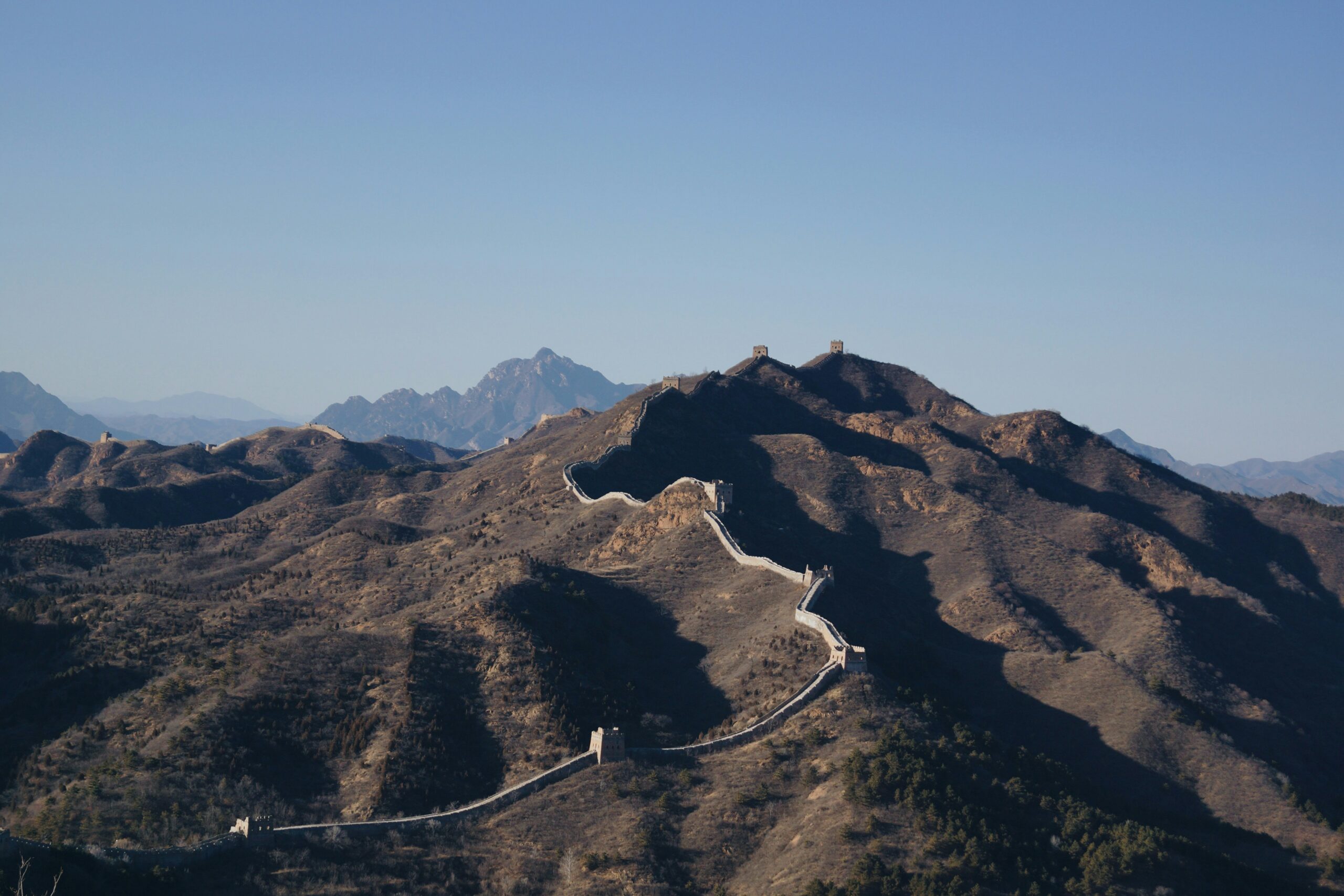
In October 2023 world leaders flew to Beijing and gathered in the Great Hall of the People, celebrating the 10th anniversary of the Belt and Road. As part of the board responsible for ‘greening’ the Belt and Road, James flew in to join those world leaders and speak from the stage.

‘On the first night of my trip,’ he recalls, ‘the deputy head of the Bar Association of Beijing gave a small banquet to honor me and the work of ClientEarth. At the dinner the number two environmental prosecutor gave a speech, saying that the legal work we have started in China would still be delivering benefits in 1,000 years.’

James Thornton with the Chief Justice of the Supreme People’s Court of China.

The next day James joined sixteen heads of state from Belt and Road countries and their delegations in the Great Hall of the People. ‘President Xi Jinping’s speech was remarkable,’ James recalls. ‘We’re used to the vagaries and hopeful or empty words of politicians. This was different. More like the CEO of a powerful company addressing shareholders. He spoke for forty minutes, all of it substantive. He reflected on the first ten years of the Belt and Road, what had worked well and what not. Then on to the next ten years, articulating eight principles. The  fourth was that Belt and Road investment is to be greened. This is important, as it is an instruction to all Chinese entities, and something we have been working for 5 years to get to. Two other points relevant to our work include that there will be established a new Belt and Road facility to link finance with green investments, which will make our work easier. And that China will train engineers and other experts from Belt and Road countries, to build up those countries’ capacity.’

Having worked with the Supreme People’s Procuratorate since 2016, James was invited to speak to the group at a convention February 2024. ‘It has been a highlight of my professional life to experience this cooperation and the extremely rapid and powerful progress the prosecutors have made.’ he told them. ‘China’s prosecutors have established specialized public interest litigation departments around the country. In the past five years, they have brought around 400,000 environmental public interest cases. Nothing like this volume of cases to protect the environment is brought anywhere else in the world.’

Among other areas they have worked on wildlife protection, river basin management, and food and drug safety. An upcoming Law of Procuratorial Public Interest Litigation will provide them with an even more robust legal basis for their work.

James is known for finding hope in the struggle for saving the planet, even after four decades on the frontline of environmental activism. His evidence of progress in China is a big part of that.  ‘Climate change and biodiversity loss aren’t going to be solved without China,’ he reflects. ‘Given global political tensions at the moment, I see our work with China on climate and nature to be an international sweet spot.’

Writing ‘The Cellist of Dachau’

May 29, 2023

Martin Goodman

This was the 21st century, and Helen Bamber was in her eighties. We met in the London offices of her Foundation, where they cared for trafficked women, and when Helen spoke she looked to the side. It was as though memories were sited there, not to be stared at head on. I had asked her to look back to her twenties, when as a young woman she volunteered to be among the first who entered the concentration camp of Belsen after its liberation.

Survivors at Belsen were skeletal. From film footage we know those images too well. What those survivors cannot do is reach out and speak to us. This was the role Helen Bamber assumed for herself. Despite their desperate hunger, Helen realized that the survivors’ keenest need was for something other than food. It was for someone to listen while they told their story. Helen listened, and became a witness to their lives.

Millions, of course, died with nobody to hear them. The Nazi state worked to strip people of their individuality. Families were separated, stripped naked, shaved, their names replaced by tattooed numbers, their bodies dressed in prison uniform, herded to mass deaths and burned. This was an industrialized operation to erase individual, racial and ancestral memory. When Helen Bamber became a witness to a survivor’s story, she offered them a rare victory. Their battle to retain individuality was won.

My progress toward meeting with Helen Bamber was a long and curious one. Summer 1997, and I was on a camping trip in the Teton Mountains in Wyoming. Bald eagles lined the river, snow packed the peaks, a grizzly bear had gone rogue, but I pressed wild strawberries against my tongue and felt at one with the natural world. And then suddenly the whole concept of what would become my novel The Cellist of Dachau slammed into me; plot, characters, wrapped around the horror of Europe’s twentieth century.

In essence, the book told of a musicologist who chases down an elderly Jewish cellist and composer. Their backstory links them to the concentration camp at Dachau, where her grandfather was the Adjutant and the musician played in a secret orchestra. She is driven by her fury, that the Jewish musician had spoken on behalf of her grandfather at his war trial.

Such was the idea, but no idea comes into an untrammelled mind. Mine had been affected by a recent obituary for the musician Herbert Zipper.

Zipper was a Viennese composer and conductor, ripped from his home and sent by train to Dachau. Once there, he was consigned to the mind- and body-breaking task of hauling rocks and sand from one place to another, and then back again. To maintain some grip on civilization, he formed a secret orchestra. Instruments were made out of scraps of wood, and manuscript paper out of old news sheets. To earn himself some time in a well-lit quiet space where he could compose the orchestra’s music, Zipper volunteered to clean the latrines at night. The music he composed in a latrine was also premiered in one – this one without its fittings. Groups of inmates passed through and listened to a series of fifteen-minute concerts.  ‘We have to see the world as it is,’ he told the Los Angeles Times toward the end of his life, ‘but we have to think about what the world could be. That’s what the arts are about.”;

My own character was a young cellist, and I decided early on that Herbert Zipper would provide the template for my character’s early life. For any hope of finding folk who the Holocaust had snatched from history, and of telling their tales, I had to anchor my characters to the historical record. A truth about being Jewish in the Reich was that your fate was not of your choosing and your destiny became inexorable. I would start my characters in one place, and then follow what would have happened to them from there.

Research immediately gave me one corrective. I expected my character to see out the war in Dachau. The biography of Zipper taught me otherwise. In advance of the Nazi pogrom of November 1938, Dachau was emptied of its Jewish inmates to make room for the planned capture of many more. Zipper was transported to Buchenwald. My character, Otto Schalmik, would have to follow the same route.

Zipper was released from Buchenwald in early 1939, and became a renowned conductor in post-war Manilla, from where he moved to California. My character took his moral fibre from Zipper’s life in the camps. One telling scene came on the Appelplatz, the camp’s parade ground, when inmates were kept standing in their rows throughout a night of sub-zero temperatures. Many dropped dead, others were frost bitten. Zipper focused his mind on the passage of the blood through his veins, from his toes to the crown of his head. He kept his circulation flowing through the force of his attention.

My book grew through many drafts. In each draft, a different character stepped forward and asked for their story to be heard. First were the mother, the sister and the niece who Schalmik had left behind in Vienna.

When the Nazis first came for Vienna’s Jews, they took the men. Some families rounded up the funds to pay the extortionate exit taxes, and because they had been targeted the men were the first in the family to leave. It was hoped that no State would vent its cruelty on women. Of course, we now know better. I decided, lazily, that my female characters left in Vienna would have been consigned to the women’s camp at Ravensbrück. Research corrected me once again.

The Jewish women of Vienna were mostly transported to Terezín (which had the German name of Theresienstadt). This Czech garrison town was emptied of its population and turned into a fortified ghetto. Up to 60,000 Jews at a time were crammed into its walls.

Terezín was an obvious setting for my novel. The composers Viktor Ullman, Gideon Klein, Pavel Haas, the next in the great Czech lineage of Janacek, worked to imbue this ghetto with a musical life. Most poignant of all was a staging of a children’s opera by Hans Krása, Brundibár. In my purist way, I intended not to use it. My musician had gone elsewhere.

But of course, his wife and sister were as musical as he. And I now knew they were sent to Terezín. I took the train and walked through the town, working to conjure it back to one weekend in 1943.

The town on that weekend in 1943 was more roomy than it had been. Red Cross Inspectors were due for a visit, and so the elderly and sick were hauled off to death camps. Streets were washed with soap, roses planted, shop windows installed, even a bank was set up. The marquee that covered the central park, in which Jews were forced to manufacture armaments, was removed. A bandstand was installed, in which the Ghetto Swingers played jazz tunes. Elsewhere a choir sang Verdi’s Requiem. And on a stage with sets designed by some of Prague’s finest designers, fronted by an orchestra, a child cast performed Brundibár.

Nazi filmmakers filmed the day. The Red Cross Inspectors were duly impressed and delivered a satisfied report. And the next day, the artists, musicians, audiences and child performers of Terezín were transported to Auschwitz-Birkenau.

Terezín was stage-managed as an act of propaganda. I wanted my novel to counter that. Imagine watching your children take to the stage in Brundibár. That is how close I wanted my readers to be. It’s a restoration of human individuality.

In reading memoirs of life in the concentration camps, it’s striking how often inmates struggled to recall their family members. Faces grew hazy, their voices indistinct, and sometimes the very names of their child or spouse vanished from memory. Inmates were stricken by a love with no details to attach it to. On a pedestal in the Jewish Museum in Sydney, a stone vessel gathers drops of water, each a tear to represent a child from among the 1.5 million children killed in the Holocaust. A wall gathers photos of some of those lost children, part of a project that collects their names. This Children’s Memorial is created by the local community in the face of monstrous evil and its purpose is to recover intimate detail.

One photo I recall from that wall is of a smiling girl in a white frock. It had been buried in a cigarette tin at Dachau. We don’t know her name or who buried it. We just know that she was once loved by someone who wanted her image at least to survive.

On my visits to Dachau and Auschwitz, I sensed a deep sorrow that blankets the camps, and interpreted this as the weight of millions of folk who never got to tell their stories. If you step inside the gates of Auschwitz-Birkenau, where long rail tracks lead toward the first of the crematoria, look right. Behind barbed wire stand the shell relics of dormitories of what was the Theresienstadt Family Camp. Unlike other inmates, families from Terezín kept their clothes and hair and names and lived together. If the Red Cross came, they could sing them a song. The Red Cross didn’t come. The families were all gassed.

I spent a week in Krakow and Auschwitz in a retreat run by the Jewish Zen master Bernie Glassman. After sitting in meditation on the railtracks we were invited to stand and recite the names of any loved ones we had lost in the camp. I stood and spoke the names of some of the musicians of Terezín and children from the cast of Brundibár. From a distance of time I had come to love them and so remember them.

[A version of this article first appeared in Jewish Renaissance.]

Piano

May 2, 2023

A home has a piano. If my mother’s childhood supplied her with a rule she didn’t break, that was it. Her two up two down house made room for an upright. Her mother could bang out any tune by ear. Her father with his Irish tenor voice would head off into song. With his drinking kept to just three half pints, life around him was a genial party.

Mum’s sister had a piano in her Leicester council house, though nobody played.

And Mum had one though nobody played.

Then I played.

This is me, then: I have a picture book of trains, bright images on thick board. A ledge pops down from the piano lid and I set my book upon it. My fingers stretch across the keyboard and I play the book of trains, turning the pages to start a new musical journey. Mum takes me to Loughborough station where we stand on the platform and watch the steam trains power in and then out again; its beating rhythm grows louder on approach and softens with distance. This is the music I hear as I play.

A home has a piano. If my mother’s childhood supplied her with a rule she didn’t break, that was it. Her two up two down house made room for an upright. Her mother could bang out any tune by ear. Her father with his Irish tenor voice would head off into song. With his drinking kept to just three half pints, life around him was a genial party.

On the turntable of my Dansette record player, Dukas’s Sorcerer’s Apprentice spins around. I crank up the volume, settle at the piano and join in. I love the piece but add what it lacks and turn it into a piano concerto.

Four is early to start piano lessons, but I’m eager. My book of trains is replaced by books of musical code and I start to read dots on the lines as music. First the right hand then the left. It’s achingly simple. My ambitions for rhythm are restrained and I produce tunes.

My piano teacher comes to tea and this is the lesson I recall, and it’s one in etiquette: A plate of jam tarts is in the centre. After the first round of people taking the tart they wanted, one desirable strawberry tart is islanded among the yellow of lemon curd. My young piano teacher is my first tea party guest.

‘You must pick first,’ I say.

‘No, after you.’

‘No, after you.’

It’s become a tussle. I think it through and then reach out and take a yellow tart.

The teacher gives me a small smile, and takes the strawberry.

We both chew. Pastry crumbs drop to our tea plates as Mum looks on and beams.

Years later I watch a TV adaptation of Bernard McLaverty’s short story ‘My Dear Palestrina’. For its soundtrack, a soprano sings Schubert’s ‘Du Bist die Ruhe’. There’s no sweeter combination of piano and voice. I read the short story. Both the story and the TV version make me weep gentle tears. Both capture the poignancy of a child’s relationship with a piano teacher.

‘You must have learned the piano as a child,’ I say to Bernard McLaverty when we meet.

It’s not so, he tells me. He doesn’t play the piano.

Here is a fresh wonder, how a writer tunes fiction into truth.

Mrs Towers’ house lies on a road between Loughborough Grammar School and home. It’s a semi-detached from the 1950s that I visit after school on Thursdays, between 4.30 and 5. The piano is in the bay-windowed front room. Sometimes an extra keyboard for the feet is stretched along the carpet, so Mr Towers can practise at home for his role as a church organist. Piano music is kept in a closed oak cabinet. A French carriage clock ticks on the mantelpiece.

Dorothy Towers is my first Arts professional. And other than teachers, she is the first university graduate I come to know. Decades before, she met her husband when they were both students. They have been settled in this house for years. Her skirt is a dusky brown, her blouse a pastel yellow or green, her hair a contained billow of light grey.

A stout girl before me fumbles her way through J.S. Bach’s Invention in F. She bursts from the room, her eyes dulled but wearing the grim smile of release. For decades children have passed through Mrs Towers’ front room in these half-hour pulses. For a break from a lesson of children’s musical fumblings the teacher takes a short turn on the piano stool, her back straight, her hands poised, her fingers arched and then she ripples or hammers across the keys so we can hear how the music might truly sound.

Mr Towers is some shadowy presence deep within the house, but this front room is a refuge where music is enough.

I am not a good student. Discipline bores me. I find no scrap of joy in practising scales. If told how to do something, anything, I immediately seek another way to do it. Mrs Towers’ urgent demand is that I concentrate on my fingering. My fingers run out of space and become entangled. Mrs Towers is not well pleased

‘I want to stop,’ I tell my mother.

‘Practise for half an hour a day,’ Mum says. ‘And go for one more lesson. If you want to stop after that, then you can stop.’

I do my daily practice and improve. I attend my lesson. I settle on the piano stool and play and Mrs Towers listens and becomes happy.

‘Was that it then?’ Mum asks afterwards. ‘You’re never going back?’

‘Why?’ I ask. ‘Why would I do that?’

Mrs Towers marks my piano music in thin lines of pencil. These books become my heirlooms.

We work through the grades, theory and practice, till I reach grade 5. I have some excuse, I forget what, but I fluff the exam and fail. We agreed to let exams be. I can simply come and play.

I offer up a Chopin Nocturne. The final notes fade and I pull my fingers from the keys. I expect some reaction. Mrs Towers is not mean with praise, but there’s silence. I turn toward her. She pulls a dainty handkerchief from her sleeve and dabs her eyes. It takes her a while to speak. ‘I’m sorry,’ she says. ‘This hardly ever happens. But that was very moving. You played it perfectly.’

We put J. S. Bach aside. It feels mechanical and isn’t working for me. ‘Don’t worry,’ Mrs Towers says. ‘It can take a while to appreciate Bach. You will love him when you’re older.’

Decades pass and I sit in the concert hall of St Luke’s for a short Bach programme by the young Icelandic pianist Vikingur Olafsson. His right hand plays an unadorned motif that cracks me wide open. The is the Fantasia in C. The fugue picks up the theme and opens it out, layer by layer, broader and broader, and I am quaking. The concert closes and I step out to sit among the tombs in the graveyard outside and weep. I manage to come back for the next concert in the programme where middle aged eccentrics are playing Bach on moog synthesizers. It violates the space the piano has set me inside and so I walk back to the graveyard where I continue to weep. The Bach piano fugue has turned me inside out, inverted me. What was hidden is now on the outside.

The music will haunt me for weeks and then for months tears will flow at the memory.

Grandfather and I – an early story

November 10, 2020

My first published story, which came out in Iron magazine in the mid 1970s. It shows its age – I was still forging my voice and this has a delicate, antique flavour – but still shows qualities. I’ve never known a grandfather of my own, by the way.

One evening there was only grass in the patch behind the house. The next morning it was filled with toadstools. Grandfather arrived in our living room like that. He sprang up through the floorboards one afternoon and was instantly established.

‘This is your grandfather, Bill. He’s going to be staying with us for a while.’ Mother turned her head to my father to stress that final part. ‘You’re not to disturb him.’

It must have been his balance that was not to be disturbed, caught so neatly as it was. A rug was wrapped from his waist, along his legs, to fall folded upon the floor. Each fold rose and dropped, forming bellows to rock the man. School had just loosened the gem of the caterpillar’s transfiguration into my mind. Now it seemed such a miracle was to happen in my own home over grandfather’s cocooned legs. I listened through the crackle of the fire for the gentle, crisper sounds of grandfather’s withered skin peeling from his legs to reveal a shining youthful beauty they once had.

Nature was being cheated of all her rules to magic the process into reality. Curtains were drawn against the day, and a fire blew out its flames and heat beside grandfather’s rocking chair. ‘We have to keep your grandfather warm,’ my mother had told me. I wondered how long skin took to dry. The fire was already challenged by the sun, which slid its own distinct patterns through the curtains as summer approached.

The top half of grandfather did not change at all. Much of him was always covered of course, swathed in jackets, pullovers, mittens and scarves; but his head was ever present on top. Silver hair was sleeked back across his skull, but the head was dominated by enormous sunglasses, two black discs that trickled occasional tears to collect inside the bristle on his cheeks. The whole face was confused by a smile that never left it.

‘Why doesn’t grandfather ever talk?’ I whispered the question to my mother in the kitchen, where we spent much of our time now. The parlour had been set aside as the old man’s bedroom to save carrying him up the stairs, and the fire roared its presence in the living room so effectively any visits but for a cursory glance proved unbearable.

‘He doesn’t need to,’ mother replied, quietly, suppressing any emotions she might have felt on the matter. I kept the remark for consideration. I had never thought of talking as being a necessity.

‘What does he do then?’

‘He thinks.’ My puzzled face prompted further explanation without my asking. ‘He just plays through all the memories he’s got, I should think. You must remember he’s a very old man.’

‘What memories are they?’

‘Really, Billy. How do you expect me to be able to answer that? That’s something only your grandfather can tell you.’ The conversation was snapped to a close as mother shoved her chair back and stood up to find some new business. It was one of those arguments designed to cheat me of a resolution. Only grandfather could tell me, while he did nothing but think.

With only one course open, the matter could be quickly laid to rest. As I opened the door the heat flew in my face. The man might have been breathing flames at me himself, I felt so nervous about approaching him. Since first finding him there I had never entered the room without company. Any words spoken had been around him, and dried in my throat now they were asked to speak direct. Finally they burst out in a voice high and unfamiliar.

‘What is it you think about?’ The sentence burnt out before its close, shutting off the polite ‘sir’ that should have followed. Convinced that I had been unforgivably rude I allowed him the briefest moment to reply, then fled. Into the garden, through the gate and scampering up the hill I was eager to make the incident as unreal as possible. Looking back down at our house, the chimney stack puffing smoke out into the blue, I knew grandfather was contained. He could never follow me across a summer’s day.

I tried to avoid the living room over the next few days, and found a powerful ally in mother. ‘It’s no place for a young boy to be in this weather,’ she said, propping the back door open to leave me a clear escape. When I had to enter I sought the wealth of shadow to hide me.

Mother occasionally whirled a cloak of busyness around herself that nothing could penetrate. Blocked by one such moment I played defiant and marched straight for the living room door. Timidity took root again as I breached the door just slightly. The airs of our two worlds mingled, then drew my head in through the gap. Grandfather was rocking still. The flames conjured up the demon through his glasses, bouncing a vivid reflection where his eyes should have been. The bellows of the rug at his feet became a concertina that wheezed a voice out of his body.

‘Hello, Billy.’ It was a thin, treble voice, unlike any I had ever heard in an adult. It seemed he had found this voice to accord with mine, and it was tingling with the game. I moved in closer.

‘Come here,’ he said, patting his mitten soundlessly upon his lap. Father would have whisked me into the air and landed me on a table; this invitation showed a delicacy I did not wish to cope with. I grew brittle with horror at the very thought of touching those knees.

‘Come on.’ The rocking stopped as the mitten padded up and down. I edged nearer, reached forward to offer a handshake, and was gripped under the armpits. The strength in his hands was unexpected, the feel of two steel hooks lifting me off my feet. I was dropped, ready to hear the violent whisper of his legs as they flaked under my weight. Instead it was like landing atop a double-barred gate, and swung as wildly. The chair rocked, shocked out of its rhythm as I grasped for its arms. I drew my body in tight, perched on this man as the chair settled.

‘You asked me what I was thinking, Billy.’

I nodded into the protracted silence.

‘What do I think?’ He suggested the question to himself, hoping the words would strike some actual meaning into his mind. ‘Whatever you do, that’s what I think. That, and a great deal more. The other day, when you ran out of here?’

I had to nod again.

‘You rushed down the garden, through the gate, and flew up the hill behind us.’

My nods came more automatically now.

‘And I was with you. That rush of fresh air was blowing in my face as well as yours. I was as happy to get out of this room as you were.’

I looked at him, and he read my question.

‘No, my body was still here. That can’t run any more. But I can leave it, relive everything you and your father do now. I’ve lived both of your lives before, you see. From this chair I can play out all your dreams.’

I recognized the language. I knew it just as I knew his voice. But I still did not see. We shared the next silence without need for nods.

‘Run along now.’ A mitten patted my back. I looked up at him a while more, tried to soak in a little of what he said, then jumped down and ran away, clicking his door shut behind me. This time I went out of the front door instead, so he would not be able to follow me. I needed to be alone. I had a lot of thinking to do.

I mooned around in such an obvious dream over the next few days it took all of father’s practicality to postpone my mother’s calling a doctor. As he predicted, I soon burst into life again. My introspection had blossomed in the wrong season, and found no way to combat the vitalities of summer. Even the butterflies ceased to perplex me, and I stalked them happily with my net, swooping them off the lilac branches and into a brief, jam-jarred captivity.

Grandfather died with the summer. The fire spent itself out, curtains were flung back, windows heaved open, and a chill was forced to stream through the room. The chair was spirited away at the same time as grandfather, but probably reached no nearer heaven than the loft.

Grandfather himself now lay in a box. The bristles had disappeared from his face, and his eyelids were uncovered from beneath the sunglasses. The body seemed sleeker within its shroud but offered no real secrets. His cheeks rouged a blatant pink, his hair bore a darker tint, the smile had been wiped down into a serene blank, whilst his eyebrows had been pencilled to arch black amazement at the whole process. I wondered where he had gone this time.

I heard the lid forced down on the coffin, watched from the window as the body was carried through the front door, and stood by the open grave as the vicar preached about the man he had never met. My father looked sad, but there were no tears. An arm stretched out to hug my mother closer to himself, maybe even bind in that embarrassed relief I had sensed in the house, a relief only suppressed by decency. Just the day before father had reverted to his jokes, feeling his way back into the living room. As the coffin was lowered, father looked away, out of the churchyard and beyond the fields. I felt grandfather sinking from sight, father fleeing the scene, and stood hopelessly small between them. Two directions showed themselves. There was no way grandfather was living all three of our lives. The first spadeful of mud dropped down to splat against the wood. ‘Ashes to ashes, dust to dust’ came the chant. Grandfather was being left to crumble. He could never escape the box to feel the same wind as I did.

My father picked me up as I wept, carried me from the churchyard and into the fields as I sobbed out all control over my body. It had surprised them both, I later heard my parents say, but then you never could tell how these things would affect the children.