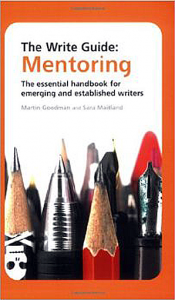
 Written with Sara Maitland, THE guide for anyone seeking to get involved in mentoring for creative writing. Pat Barker writes of the book: “Mentoring is an important area of development for writers. I’m pleased that New Writing North are publishing this guide, which is not only an indispensable tool for writers, but highly readable too.”
A Reader’s Group Guide to Slippery When Wet
September 28, 2006 Why select Slippery When Wet for your reader’s group?
The writer Sara Maitland says of it:
“I’m not sure how Martin Goodman has pulled this extraordinary novel off – so moving and so funny; so sharply acute and so generous hearted; so translucent and so intelligent; so honest and so hopeful. Should work for both sunny days and cold nights.”
It’s a brilliant ‘older woman meets younger man’ story. Maggie, the 60 year old matriarch of an English stately home, is the older woman. Sepen, aged 21, scraping a living by meeting visitors at Dhaka airport in Bangladesh, is the young man.
Love across so many divides – age, religion, culture – give plenty of scope for heated conversation. Cheer it along with a glass of wine and see what hopes and thoughts it inspires in your group.
Is it a tough read? No, it glides past. Martin Goodman’s novel On Bended Knees was shortlisted for the Whitbread First Novel Award. The Daily Post said it ‘heralds a new dawn for British fiction”. The Times: ‘Goodman writes with flare and panache, and the narrative fizzes along’. The Observer said ‘it slips down like a milky cuppa’!
For armchair travellers, the trips through the streets of Dhaka, the coastline of Cox’s Bazar (the world’s longest beach), the temples of Bangkok and the Bridge over the River Kwai are real treats.
It’s affordable – a 2006 novel, sparklingly new, at a top price of £7.99 and less than half that on some offers.
And if you want questions to kickstart your reader’s group conversation, here are a few. Martin’s own ‘viewpoint’ is there to get each one started.
1. Can a male writer create a female character?
Author’s Viewpoint:
Maggie’s utterly real to me, and Flick too. They are women, and Sepen is a young orphaned Bengali, all different from my own direct experience. Characters grow until they become themselves. Maggie’s now so independent she’s marching out of my book and into other readers’ heads. I’m intrigued to know how she behaves.
2. Does travel broaden the mind?
Author’s Viewpoint:
For me, it has been vital. Travel in Muslim countries has been especially illuminating. Many women friends, for example, loved Turkey, and feel unusually safe there. It’s a question though with Maggie – did travel change her, or simply let her loose on a wider and more varied landscape?
3. Is Maggie likeable? Does a lead character need to be?
Author’s Viewpoint:
She’s tough. I love her. Is she likeable? Hmmm.
4. What sense of Bangladesh do you get from this book? Would you ever want to go there?
Author’s Viewpoint:
I came to know some Bengali families in Britain, and was keen to discover the country which had made them – so travelled out there for a couple of research trips. It felt important to engage the reader with Maggie in England first, then have the reader travel with her perspective.
5. Should we become ‘more responsible’ with age?
Author’s Viewpoint:
Flick has the most ‘responsible’ lines in the book. The young have the confidence of knowing what’s right. Wisdom maybe dims all such certainties.
6. What aspect of Maggie and Sepen’s relationship most challenges you?
Author’s Viewpoint:
Their relationship simply exists for me, it grew naturally and I charted it. The part that I found hardest to discover was how a relationship can grow when one person is sick.
7. What might you like to do which would shock younger members of your family?
Author’s Viewpoint:
The question arises from the relationship between Maggie and Flick. My own answer? Tell everything as it happened.
8. Who would you have play Maggie in a film?
Author’s Viewpoint:
Maggie Smith could voice the lines. There’s a host of great actors of around 60.
9. Who else would you see enjoying this book?
Author’s Viewpoint:
I reckon anyone of any gender or age, providing they’re open, could have a great time with it. Jane Austen used to be marketed to men, and now she is marketed to women – fashions change, Jane Austen stays eternal.
10. What does Slippery When Wet tell you about Englishness?
Author’s Viewpoint:
You can understand Englishness by carrying it overseas, seeing it in a different light. Englishness is a quality that isn’t fixed. It’s always absorbing different cultures.
11. What’s the most vivid scene in the book?
Author’s Viewpoint:
It’s interesting just to go quiet with this question a moment, and see what different scenes you come up with. Then maybe wonder why.
12. What happens next?
Author’s Viewpoint:
The book once ran beyond the point where it now stops. I was reading the manuscript one day, and knew with a flood of truth down the spine that it must stop where it does. But how would you see it continuing?
Why not call in the Author?
Feel free to get in touch with Martin Goodman ( [email protected] ) if you want any extra help in setting up your readers’ group session. He’s happy to phone and chat to the group if you get a speaker phone, or visit if he can be in the area. Email him on: [email protected]
Slippery When Wet
January 13, 2006Why the critics love Slippery When Wet:
I’m not sure how Martin Goodman has pulled this extraordinary novel off – so moving and so funny; so sharply acute and so generous hearted; so translucent and so intelligent; so honest and so hopeful. Should work for both sunny days and cold nights – Sara Maitland, author of On Becoming a Fairy Godmother
See Martin Goodman’s author profile, special offers and sample chapter at Transita.
On Sacred Mountains
May 1, 2002 Mountains, though they might seem to be merely big bits of rock decorated with snow and trees, are in fact “great teachers”. Nipping up summits the world over, Goodman finally finds one that talks. Yes: Guadaloupe Peak, Texas, is a speaking mountain. It says to him: “All you need is love.” (Why can’t mountains like the Beatles, too?) Later on, Goodman begins “to suspect, and also to fear, that I was to be a prophet of a new world order”. Indeed. Either an important spiritual document, or an admonitory example of the effects of oxygen deprivation. – The Guardian. Decide for yourself. The book stems from years spent travelling to the sacred mountains of the world.
Order On Sacred Mountains through Amazon.co.uk
Download the Kindle edition of On Sacred Mountains
I Was Carlos Castaneda
May 28, 2001 The famed writer and sorcerer Carlos Castaneda steps back from the dead to lead Martin Goodman on a chase through the French Pyrenees, in search of the secrets of shamanism, hallucinogens, religion and lost youth.
About the Book
Many westerners are attracted to the rites and practices of religions and traditions from other cultures. In doing so it is easy to be dazzled by what is glamorous and therefore be blinded to what is dangerous. When I wrote about my deep experiences with the guru tradition in In Search of the Divine Mother I aimed at a balanced perspective. I gained a lot from that period, so did not want to disavow it, but had learned a great deal that might help and protect other westerners along a similar path. That is why the book had to be published.
I feel the same way about I Was Carlos Castaneda. Psychedelic medicines, especially ayahuasca, are becoming increasingly popular. I have gained tremendous teachings from them myself. I was also nearly killed by the shamanic nature of the associated practice. I was naïve. I believed there was no such thing as “black magic.” While people might practice such a thing, I thought it was belief in black magic that gave it its power. I was wrong. I did not believe in black magic, yet I became its victim.
Looking at plant medicines, ayahuasca, shamanism, it is natural that people are attracted to the light, the wonderful aspects. Shamanism itself is not shy about its darker side, but people coming to it from other cultures are likely to be as naïve as I was. This book is something of a survivor’s guide … it details both the wonders and the danger.
Don Pedro in the book is a fusion of two shamans. While in the Amazon I reached an agreement with one of them to write his biography, interviewed him accordingly, and came away with an extensive set of initial notes. Then my illness occurred … and forced me into a reexamination of my whole experience. The research into the biography had helped formulate my views on shamanism. It also provided me with a whole host of stories I cold possibly use. I took great care not to use stories that had been given to me particularly for the purpose of that biography, since I felt they were no longer mine to use in such a way. However one story did creep in, a tragic love story of the shaman. As I was preparing my manuscript for submission I looked at the story, wondered about deleting it, then thought “What the hell” and pressed the save key on my computer to leave it in. As my hand came up from pressing the key, a wasp stung it. I went back and deleted the passage. It could be coincidence, but this was my first wasp sting in thirty years. It was so in accord with my experiences of shamanism, which uses nature as its vehicle, that I felt justified in my wariness of going public with this story.
Some months after pausing in its writing, I read what I had done. And liked it. I found it to be tender and safe and lyrical and good. It was a story that asked to be finished. Once I had written it up, it wasn’t till reading Carlos Castaneda’s story of how he came out of the jungles of Peru, of hearing these recreations of his comments and wisdom, that I saw a new element of what he was doing. They say that once taken, ayahuasca never leaves you. I came to see that Carlos was actually continuing the teachings of ayahuasca, bringing some of its wisdom to the far side of my own experience.
The book ends with a promise that he will come again, that I will have the chance to pose one final question to him. Has he yet? It’s funny. I catch glimpses, nearly catch him, then he’s gone. I’ve written about these times. But that next real appearance? I’m still waiting.
Reviews of I was Carlos Castaneda
Such narrow, narrow confines we live in. Every so often, one of us primates escapes these dimensions, as Martin Goodman did. All we can do is rattle the bars and look after him as he runs into the hills. We wait for his letters home. ~ Susan Salter Reynolds, The Los Angeles Times
A marvelous book with rich teachings that particularly touch the heart of death — and, thus, life itself. ~ Thom Hartmann, author, The Last Hours of Ancient Sunlight
From the Pyrenees to the Amazon rainforest, Martin Goodman vividly describes Castaneda’s most powerful and important teachings-the nature of the journey beyond death. ~ Alberto Villoldo, Ph.D., author of Shaman, Healer, Sage and Dance of the Four Winds
The Old Trickster has done it again! Having stirred up a storm of controversy and speculation in his lifetime with his astonishing tales of sorcerers and shamans, Castaneda now makes a posthumous appearance in Martin Goodman’s story. But now Goodman plays the role of bewildered student, to Carlos’ amused and provocative pronouncements. ~ Ralph Metzner, Ph.D., author of The Unfolding Self
This is an absorbing tale, which succeeds at entertaining while it informs. Goodman, writing with warmth and humor, has woven a story of a modern day shaman’s apprentice, cast adrift amid the turbulent outer zones of consensus reality before returning once again to solid ground. It is a delightful read, and I recommend it highly. ~ Charles S. Grob, M.D., Professor of Psychiatry at the UCLA School of Medicine
In the beginning, I thought this was a book of metafiction or magical realism. It is something else entirely: a discussion between new friends, a dreamy travelogue, a teaching. It is a magical mystery tour in humility, truth, death, betrayal, forgiveness, the envelopment of nature, written as clearly and powerfully as a French Pyrenees river where Goodman and Castaneda stop to swim and talk. ~ Karla Kuban, author of Marchlands
Carlos Castaneda lives! Martin Goodman is a mystic, poet and superb storyteller, and with his rare combination of gifts he has brought the legendary sorcerer’s apprentice to vivid life in this enchanting tale about life and death, truth and illusion, fate and freedom. ~ John Horgan, author of The End of Science
To invite someone like Carlos Castaneda into one’s life, especially when he’s dead, is asking for it. Martin Goodman, who barely escaped death in Amazonas, gets the full treatment from the old master and learns a thing or two to his own and the reader’s advantage. To Castaneda’s, too: I reckon he’s in better form than ever before. ~ Francis Huxley, author of The Way of the Sacred
In Search of the Divine Mother
September 7, 1998 In Search of the Divine Mother (Harper Collins, 1998) is a groundbreaking study of the origins of religion, tracing the life and career of an Indian woman (Mother Meera) worshipped by many thousands as God on earth.
Reviews
Given rare access to Mother Meera’s inner circle, journalist Martin Goodman began as an innocent pilgrim. As his investigative journey continued Goodman not only separated truth from fiction, but discovered something about his own spirituality. Offering a travelogue to the soul, Goodman uncovered not only the phenomenon of Mother Meera, but the source of what makes all of us seek a higher meaning, a transcendent purpose, the promise of something divine. IN SEARCH OF THE DIVINE MOTHER, provides valuable insight into the nature of the guru-disciple relationship and brings to light much of the mystery surrounding Mother Meera’s contemporary Christ-figure. Goodman offers a deep, personal insight that layers biography with a mesmerizing spiritual sojourn. – Turtle River Press
Martin Goodman is a writer with a gift for description. This book offers a fascinating account of a woman some believe is an incarnation of the feminine divine. – The New Mexican
This is a loving chronicle of what could easily be viewed as a soap opera. … It’s a fascinating, engaging story full of appreciation for the wondrous synchronicity that brought Mother Meera to the world. – The Napra ReView
When English novelist and essayist Martin Goodman sent his guru Mother Meera a draft of his book about her for suggestions, she had only one: destroy this book. Goodman’s devotion is so complete that he complies. In rewriting the book, he is forced to work through his deep-seated anger. He embraces his homosexuality. Most important, he realizes that the key to finding peace is to hold on to nothing but to savor everything. “We have an infinite capacity, but it is not one of containment,” he writes. “It is one of processing.” Goodman blends an unyielding introspection with thorough research in his portrait of the infamous avatar. ……. Though Goodman’s account might lead skeptics to believe that this goddess was made, not born, the author remains impassioned. – Mick Macleod, New Age Journal
Goodman’s spiritual link with Mother Meera, a contemporary Indian mystic who connects with her followers by means of her steady gaze and purportedly transformative touch, began long before meeting her in person. Goodman practiced transcendental meditation and traveled through Asia, visiting holy sites, but eventually sought a way beyond systems and communities, a path not predicated on woundedness but that promised wholeness. Encountering Meera at her German base of operations, he met others there on similar pilgrimages (including eventual life partner James) and found the capability within to expose the secret, hated parts of himself to the divine light. An insightful testimony from a onetime devotee of its putative subject, who, whether or not she is, as some contend, God on earth, remains a gifted seer and worth the attention of browsers of the spiritual fulfillment shelves. – Booklist , March 15, 1998 The book is not the sensationalist exposure one might have expected; it rings with painful truthfulness and impresses one with its fine sensitivity and clarity of thought and expression. – Anita Desai, author of JOURNEY TO ITHACA
A significant, illuminating contribution to the anatomy of the guru-disciple relationship. -Olga Kharitidi, M.D., author of ENTERING THE CIRCLE
For readers struggling with complex issues of the master-disciple relationship, and the mind-bending clash of the skeptical mind with the mystic view, Goodman’s superb book will come as a long-awaited reality check. Both analytical and profoundly personal, IN SEARCH OF THE DIVINE MOTHER–the only reliable biography to date of the modern master known as Mother Meera–is an illuminating account of the author’s efforts to separate truth from make-believe and to bridge the gap between the inner and outer teacher. Gifted with the ironic eye of a novelist and the tender heart of a born seeker, Goodman manages to explode the legend surrounding Mother Meera while preserving the mystery behind her silent touch. Very inspiring. – Mark Matousek, author of SEX DEATH ENLIGHTENMENT