New Generation Thinker

September 24, 2013

Here’s a wee film I made about about Haldane while also setting a writing challenge, made by the Review team up at the BBC in Glasgow. It was made as part of a recently finished stint as an AHRC / BBC New Generation Thinker for 2012-13. Here is the first short essay, five minutes worth of Bad Air from Night Waves

From the Essay slot, here is Living the Lives of Others, a fifteen minute essay on biographical practice. And for my contribution to a panel discussion on Buddhism and violence, go 29.18 minutes into this Night Waves edition: Night Waves Dec 4 2012

 

Look Who’s Watching

February 21, 2011

Look_Whos_WatchingAs TV cameras roll, a Tibetan boy lama is assassinated in Santa Fe, New Mexico. The event is a coup for media mogul Mark Rider, a triumph for Chinese General Xi, and a tragedy for top Hollywood actress Susan Groves. As Susan chases the truth, she is chased in turn, the media tracking her down to a love tryst on the English coastline. Death happens, but it is not the end. The boy lama peers out at media mogul Rider from the afterlife, and is born again as one of Rider’s twins. Retribution comes.

Here is a trailer for my supernatural thriller Look Who’s Watching from Caffeine Nights.

Buy on Amazon.

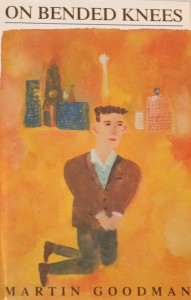
On Bended Knees

February 17, 2011

One BenLife’s uncomfortable for Tomas Christie, an English boy with a German mother. He travels to Dresden and a divided Berlin to investigate the German side of his nature, his blind ex-Nazi uncle his guide to the bitterness and hopes of a new Europe. Shortlisted for the Whitbread First Novel award.

Reviews

A perceptive, moving novel. Martin Goodman takes fierce delight in cutting through the easy cliches about the “new” Europe. ~ Christopher Hope

A first novel of deceptive simplicity, which casts an absorbed and occasionally chilling eye over the complexities of family life, national identity and the horrors of recent European history. ~ D.J.Taylor

Goodman’s quirky first novel heralds a new dawn for British writing. ~ Malcolm Handley, Daily Post 

This excellent first novel’s central character is so completely realised he could have walked out of one of those enigmatic Bruce Chatwin pieces about old mysterious European types. Its basic, simplistic construction combines notions of guilt, memory, family and love into a book that’s built to last long after the sell-by date of most first novels. I would be surprised if this didn’t turn out to be one of the most promising debuts of the year. ~ David Darby, Time Out

The best debut is ON BENDED KNEES, Martin Goodman’s quirkily charming novel that interweaves a young man’s search for selfhood in provincial Britain with the mysteries of his mother’s German past. ~ Natasha Walker, Vogue

The novel’s blunt, no-frills economy is part of its charm. Goodman writes with flare and panache, and the narrative fizzes along. Goodman’s novel soars. ~ Michael Wright, The Times

ON BENDED KNEES is a professional combination of rite-of-passage novel and cultural quest. The troubled half-German adolescent hero, Tomas, goes to stay with relatives in Berlin, following the disturbing death of his father. That city is brilliantly seen through the hero’s eyes, as is the character who effectively steals the novel, the blind and autocratic Herr Poppel. The novel comes most to life when Tomas and Poppel are taking their walks around the divided city’s streets and parks, the older man dispensing the secrets of longevity, the younger man hesitantly challenging him on the implications of his cast-iron pronouncements and their relation to Germany’s guilty past. A very impressive debut. ~ Colin Donald, The Scotsman

… After Collins’s gut-scraping poteen, the emotional tact of Martin Goodman’s ON BENDED KNEES slips down like a milky cuppa. Yet Goodman’s plot unfolds against a backcloth of even deeper red. Tomas grows up with his German mother in the postwar Midlands, a place of oozing war-wounds where a gung-ho film or a World Cup tie can split his heart in two. “We carry old deaths within us,” warns his dying teacher and Tomas must turn pilgrim in Dresden to make peace with his family’s past. This quiet and subtle study of reconciliation tends to stick with English understatement and eschew German grandeur. No matter, Britain has squads of youngish writers trained to squeeze the last drop of moral juice out of the Second World War and its aftermath. It takes a braver soul, like Goodman, to hint that postwar babes should try instead to lay these ghosts to rest. ~ Boyd Tomkin, The Observer

ON BENDED KNEES is puzzling at first, because Tomas, who wants to tell his own story with proper attention – ‘on bended knees’ – seems to have very little personality, or even particular preference. But you come to see that he is conserving himself deliberately against the old suffering, the tired old guilt of the adults. He is biding his time. DJ Taylor has called ON BENDED KNEES “deceptively simple”, but I can’t see what’s deceptive about it. Simplicity is a great virtue, in novels as elsewhere. After all, it can only be produced from sincerity. ~ Penelope Fitzgerald, The Evening Standard

Buy on Amazon.

Audio interview with Hilary Mantel, just after winning the Booker Prize for Wolf Hall

December 9, 2009

[hmp_player playlist=’Martin_Goodman_Interviews_Hilary_Mantel’]

Hilary Mantel & Martin Goodman

Hilary Mantel & Martin Goodman

The winner of this year’s Booker Prize for her novel Wolf Hall, which draws us into Henry VIII’s court through the scheming life of Thomas Cromwell, Hilary Mantel is one of the most brilliant and wide-ranging writers of our times. We are delighted to hold this event, in which Hilary Mantel will be discussing (with Martin Goodman) the span and the inspiration for her life’s work.
Recording of an event held at the University of Hull on Wednesday 9th December 2009.  


Audio interview with Jill Dawson, about her novel of the life of Rupert Brooke

November 11, 2009

[hmp_player playlist=’Martin_Goodman_Interviews_Jill_Dawson’]

Jill Dawson

Jill Dawson

Novelist Jill Dawson leads us on the journey of her re-creation of Rupert Brooke’s life. Her novel The Great Lover follows Rupert Brooke from summer love in Cambridge, through romance in Tahiti, to his extinction in the First World War. The poet comes more clearly to life here than in any biography.

Recording of event held Wednesday 11th November 2009. 


Suffer and Survive

July 26, 2008

Suffer_and_SurviveThe first biography of the astonishing scientist Dr J. S. Haldane, Suffer and Survive.

Martin Goodman begins his excellent biography of John Scott Haldane with a vivid account of the Tylorstown disaster. He has a novelist’s eye for evocative detail that lesser writers might miss and the result is as compelling as a historical novel – The Times

Martin Goodman’s vivid and reverential biography is, incredibly, the first ever published about Haldane, a medical adventurer in an epic quest to personally explore the limits of human endurance and save lives… Suffer and Survive is much more than a litany of the gruesome realities of the industrial revolution and is often surprisingly funny, littered with anecdotes and quotes from Haldane’s letters… Goodman successfully avoids what might have been a dry academic study and delivers – to use Victorian terminology – a darn good yarn about a darn good man while weaving through a maze of scientific facts and figures. – The Scotsman

Fascinating … Goodman writes enchantingly – The Literary Review

Thrilling – Daily Telegraph

Highly enjoyable. It is a fitting tribute to a pioneer who enabled the human body to survive at the extremes of modern life. – Nature

A fascinating portrait of an indomitable Victorian who deserves to be better understood and celebrated. – Christopher Hudson, Daily Mail

Martin Goodman’s work is literary and intimate. At times, Haldane could easily have been one of Dr Jekyll’s colleagues in Stevenson’s classic novella. The strong sense of dynamic enterprise, however, never detracts from the scholarship which underpins Goodman’s work. – Financial Times

Martin Goodman offers us a rounded portrait that does justice to both Haldane the man and Haldane the scientist. Goodman’s own website emphasises his credentials as a mystic, poet, novelist and teacher of creative writing, which makes Haldane seem an odd choice of subject. Nevertheless, Goodman clearly empathises with Haldane and narrates the various scientific debates in which Haldane was involved from Haldane’s side. This biography flows easily along, and the chapters on Haldane’s researches on nerve gas and the other barbaric innovations of the First World War are particularly moving. Goodman has made good use of a variety of archival as well as the standard printed sources. – The Times